Now Reading: Dr. Anna Kirtava, MD, PhD: The Bridger Redefining Healthcare Innovation, AI Governance & Global Health Equity | The Pulse Magazine
-
01
Dr. Anna Kirtava, MD, PhD: The Bridger Redefining Healthcare Innovation, AI Governance & Global Health Equity | The Pulse Magazine
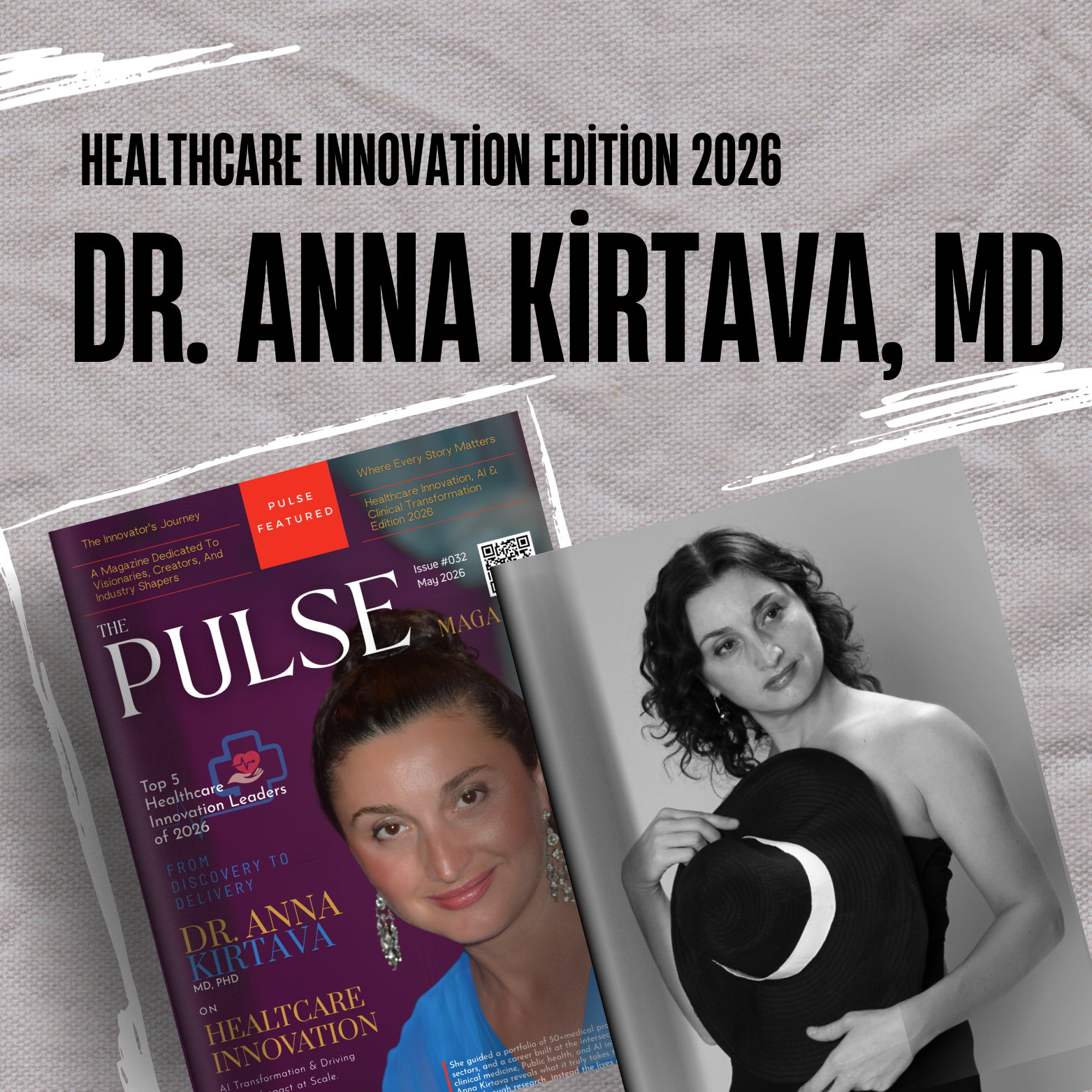
Dr. Anna Kirtava, MD, PhD: The Bridger Redefining Healthcare Innovation, AI Governance & Global Health Equity | The Pulse Magazine

Dr. Anna Kirtava, MD, PhD: The Bridger Redefining Healthcare Innovation, AI Governance & Global Health Equity
There are leaders who occupy their field, and then there are leaders who redefine it. In the May 2026 Healthcare Innovation, AI & Clinical Transformation edition of The Pulse Magazine, we meet a rare archetype of the latter: a professional biography so richly layered, so consistently purposeful, and so genuinely committed to human-centered impact that the challenge is not finding enough to say, but deciding how to say it all.
Dr. Anna Kirtava, MD, PhD, does not fit standard professional taxonomies. She is a physician-scientist, an AI governance leader, and—most precisely—a Bridger. Based in Atlanta and working internationally, she has spent fifteen years navigating the complex intersections of modern medicine: between laboratory and clinic, between policy and bedside, between global innovation and local access. Her argument is both simple and radical: the most sophisticated breakthrough in the world means nothing if it does not reach the human being who needs it.
The Origin of a Bridger: From Medical School at 16 to the Bedside
Every transformative career has an origin story. For Dr. Kirtava, it began at sixteen, when she was accepted into medical school. “I literally ran hugging strangers,” she recalls. “That joy, that sense of purpose, has fueled me ever since.” That happiness was not the shallow relief of academic achievement, but the confirmation of a calling toward human vulnerability.
She trained in obstetrics, where the stakes are immediate and unmistakable. It was here, in the intersection of life’s most profound threshold moments, that she discovered what would become the gravitational pull of her entire career: the irreplaceable necessity of human connection. During one hospital blackout, with no monitors, no algorithms, and no institutional scaffolding, she delivered a baby by instinct and touch. The mother named her daughter after the doctor. Decades later, as Kirtava advises on half-billion-dollar medical portfolios and architects governance for artificial intelligence in healthcare, she returns to that night as her true north: the machine cannot hold a hand. The algorithm cannot make eye contact across the dark.
Scaling Systems: From CDC Surveillance to the Pentagon Portfolio
If the bedside taught Dr. Kirtava the importance of human judgment, the systems level taught her that individual practice, however meaningful, could not contain her sense of purpose. “Healthcare isn’t just treatment,” she realized. “It’s infrastructure, prevention, equity, and systems thinking.”
She moved to the Centers for Disease Control and Prevention (CDC), leading surveillance across 146 centers and emphasizing care for 6,000+ patients. The scale was staggering, but the mission was clear: understand the system in which care is delivered, because decisions made at the level of policy and program design affect what is possible in individual patient interactions.
From the CDC, she transitioned to the Department of Defense (DoD), where she would take on one of the most consequential leadership responsibilities of her career. As a guide and director of a portfolio worth approximately $450 million, covering 50+ distinct medical programs and facilitating with 420+ scientists and clinicians, she witnessed firsthand why brilliant science so often fails to reach patients: misalignment. Researchers, clinicians, policymakers, and patients speak different languages. Without a translator, the translation gap swallows the innovation.
Her response was to build what she calls **“The Bridger Instinct” **the capacity to connect worlds that cannot reach each other on their own. It does not merely make introductions; it builds the structural conditions for genuine collaboration and holds those coalitions together through the hard years of implementation.
Building From Absolute Zero: The Caucasus Hemophilia Program
Perhaps the most compelling evidence of Dr. Kirtava’s method is not found in a boardroom or a policy paper, but in the Caucasus, where she built a hemophilia care program from absolute zero: no funding, no infrastructure, no registry, no government support. By aligning stakeholders around patient-centered outcomes rather than institutional ego, by building local capacity rather than parachuting in expertise, she enabled more than three hundred patients to receive comprehensive care, reduced emergency hospitalizations by forty percent, and created a program that continues to function and to be locally funded without her presence.
This is what genuine sustainability looks like in global health work. It is not a program that continues to depend on external expertise and external funding, but a program that is built on the local capacity and the local institutional commitment to continue what the external actors who helped create it began. The hemophilia program’s sustainability was not accidental; it was the product of deliberate design of building local capacity from the beginning, of involving local leaders in every design decision, of creating financial structures that could be transitioned to local government ownership.
AI Governance & The Future of Responsible Innovation
Today, Dr. Kirtava’s bridging work extends to the frontier of artificial intelligence. She sees AI’s genuine transformative potential: predicting disease before symptoms, selecting therapies based on individual biology, accelerating drug discovery through quantum computing. But she insists on governance that keeps humanity central.
“Validity is not defined by the system,” she says. “It is defined at the bedside.” Her framework demands diverse training data, transparent mechanisms, continuous clinical validation after deployment, and the preservation of clinician override authority. She warns that AI deployed without equity as a design criterion will widen, not close, the gap between the privileged and the underserved.
Dr. Kirtava engages with AI from a position that is unusual and valuable: she has the clinical depth to understand what medicine actually needs, the systems experience to understand how healthcare organizations actually work, the research background to evaluate rigorously, and the governance expertise to understand what responsible deployment actually requires. She is neither an uncritical enthusiast nor a reflexive skeptic. She is a precise and demanding evaluator of what AI can actually do, what it cannot do, what it risks, and what responsible governance of it looks like.
The Five Values That Guide Everything
Across every role, every institution, and every country, five values define Dr. Kirtava’s practice:
- Human Dignity: Does technology amplify human judgment, or replace it? The person receiving care must remain the center of every decision.
- Transparency: Name gaps, tensions, and hard truths. Honesty builds trust more than polish ever can.
- Rigor: Science matters. Innovation must be scientifically sound. Good intentions backed by weak evidence are not enough not when the stakes are human lives.
- Equity: Innovation reaching only the wealthy is not innovation it is widening an unacceptable gap. Breakthrough care must reach everyone.
- Pragmatism: You do not solve healthcare overnight. Start with one program, one center. Build systems that scale. Prove the model, then expand it.
- The Throughline: Human connection. Across every role, every institution, every country the patient is in the room. Always. This is what does not change.
Three Pillars of Transformation
Dr. Kirtava’s career can be read through three pillars that define her practice:
- Innovation Translation: Converting breakthrough science into real-world patient benefit. This means understanding the funding landscape, the regulatory pathways, and the commercial viability in terms that a venture investor would find compelling while maintaining the scientific integrity that the academic institution appropriately demands.
- Partnerships and Stakeholder Alignment: Building and sustaining the coalitions that make systemic change possible. This is not networking; it is the harder work of creating mutual commitment, staying engaged through implementation, and holding coalitions together when momentum fades.
- Execution: Ensuring that vision, strategy, and resources translate into programs that actually work, at scale, without the architect. The Bridger’s work is never done, but it is always most meaningful when the systems built continue to serve long after the initial surge settles.
The Human Imperative: Why Presence Matters More Than Algorithms
For all her genuine excitement about the transformative potential of AI in healthcare, Dr. Kirtava is equally clear and emphatic about what AI is not and cannot be: a replacement for human judgment in the delivery of care. The distinction she draws is precise and important. An AI system that supports a clinician in making better decisions, that provides the clinician with relevant pattern recognition from large datasets, flags potential diagnoses for consideration, highlights drug interactions or contraindications, or identifies patients at higher risk who might benefit from proactive intervention is a tool that amplifies human capability.
But an algorithm that makes clinical decisions without human oversight is something qualitatively different, and qualitatively dangerous. The physician of the future, in her vision, is an orchestrator rather than a solo practitioner. Where the contemporary physician aggregates and applies a body of clinical knowledge that is, while vast, in principle knowable by a single person, the future physician will work in an environment where the relevant information is the patient’s genomic profile, the AI-generated differential diagnosis, the precision medicine recommendations, the population-level data on comparable patients generated by systems that no individual clinician could replicate.
Advice for the Next Generation of Healthcare Leaders
When asked what she would say to emerging leaders in healthcare innovation, Dr. Kirtava’s advice is characteristically focused on the human dimensions of the work rather than the technical ones. Listen more than you talk. This is not merely a communication skill; it is an epistemic practice a way of communicating that your understanding of the situation is adequate to the decisions you are making about it.
In healthcare, the situations are complex and the people who understand them most completely are often not in the most powerful positions. Patients understand their experience of disease in ways that clinicians do not. Frontline clinical staff understand the operational realities of care delivery in ways that administrators do not. Community members understand the social determinants of health in their communities in ways that outside experts do not. Listening real, sustained, genuinely open listening is what makes it possible to learn from these perspectives and to design responses that are adequate to the realities they describe.
Conclusion: The Ending That Is Also a Beginning
Dr. Anna Kirtava has spent more than fifteen years doing exactly that kind of work. The journeys documented in these pages are not a summary of a career completed. They are chapters in a story still being written a story about what is possible when a person with the right values, the right skills, and the right commitment decides that the gaps are too important to leave unbridged, and walks toward them every day.
“In the end,” she says, “what sustains us isn’t algorithms or systems or technology. It’s humans showing up for other humans. It’s presence, empathy, genuine care for people we serve. That’s what has always mattered. That’s what always will.”
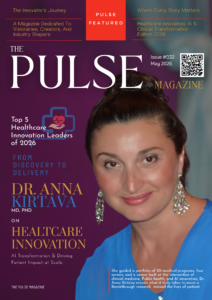
Read the full special editorial feature in The Pulse Magazine, Issue #032, May 2026: Healthcare Innovation, AI & Clinical Transformation Edition.
About The Pulse Magazine
The Pulse is a magazine dedicated to visionaries, creators, and industry shapers. Where every story matters. For more features on the leaders shaping the future of healthcare, visit thepulsemagazine.com.
Previous Post
Next Post