Now Reading: Engineering the Future: Carl D. Hays III on AI, IoT, Decision Intelligence & Responsible Leadership
-
01
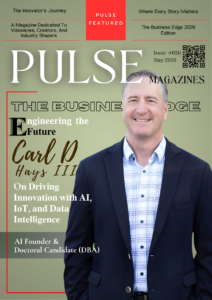
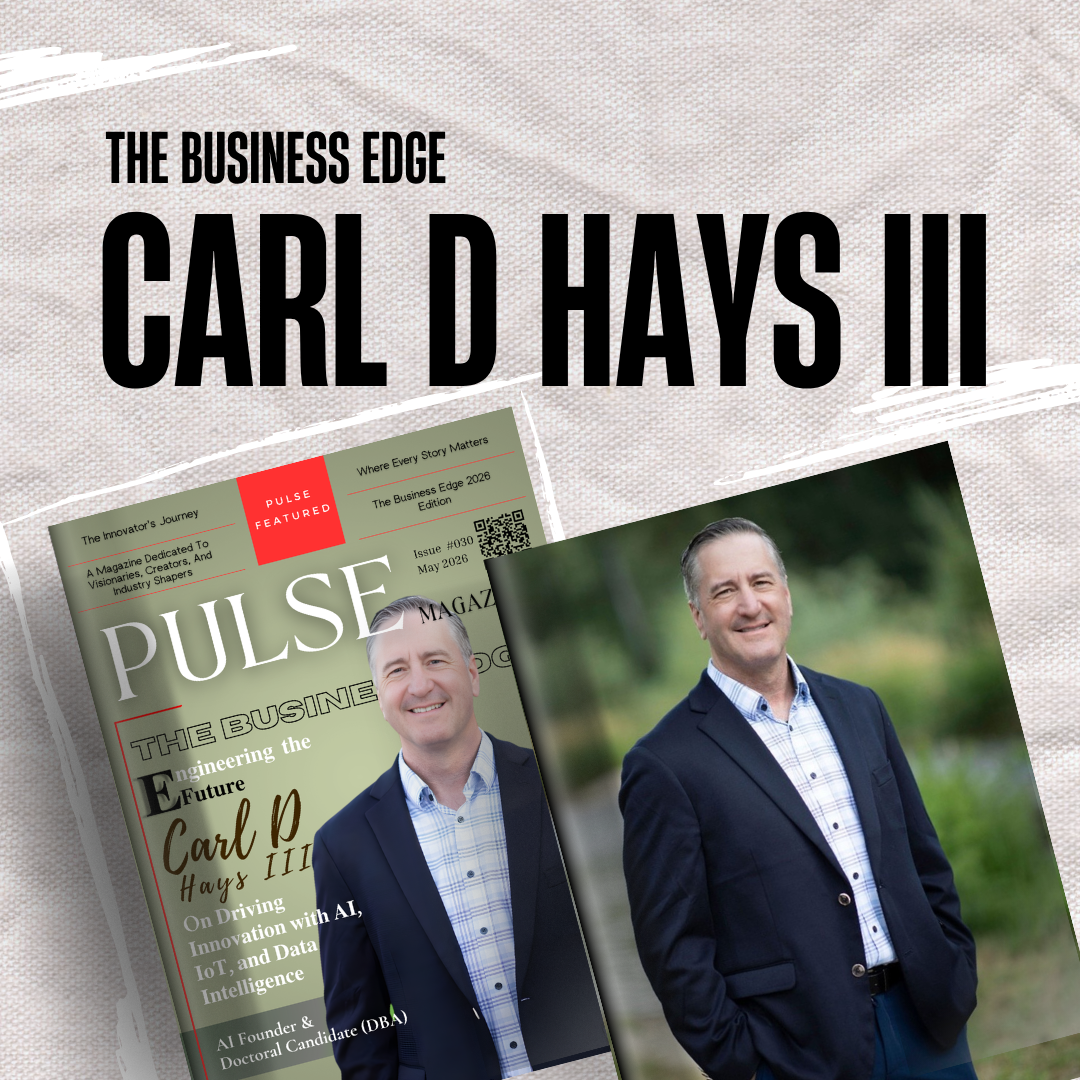
Engineering the Future: Carl D. Hays III on AI, IoT, Decision Intelligence & Responsible Leadership
Engineering the Future: Carl D. Hays III on AI, IoT, Decision Intelligence & Responsible Leadership

By The Pulse Magazines Editorial Team
In an era defined by breakneck speed, constant disruption, and a relentless flow of information, clarity has become the most valuable currency in leadership. Every day, modern decision-makers are bombarded with dashboards, data points, and predictive trends. Yet, despite this abundance of information, many still struggle with the same fundamental question: “What should I do next, and why does it matter?”
The challenge of the modern age is no longer the access to information; it is the ability to transform overwhelming complexity into confident, decisive action. This is the philosophy that drives Carl D. Hays III.
Carl is not a leader chasing headlines or fleeting tech trends. As a CEO, Founder, and Doctoral Candidate (DBA), he occupies a rare intersection of academic research and gritty, field-level execution. His work doesn’t happen in a vacuum or a sterilized lab; it is forged where data meets dirt, steel, weather, and time.
For Carl, the goal isn’t just “innovation”—it is Engineering Certainty.
Where Theory Ends and Reality Begins
In the real world, failure is not an abstract data point. In the industries Carl serves agriculture, construction, and energy the stakes are physical, expensive, and immediate. A crop doesn’t wait for a better data model to be developed; a construction schedule doesn’t pause for a cleaner dashboard; an energy system doesn’t forgive uncertainty disguised as “insight.”
Across these sectors, Carl has emerged as a leader who rejects “innovation for its own sake.” Instead, he focuses on engineering certainty where it matters most: in decisions made under extreme pressure.
“Reality doesn’t care how elegant your model is,” Carl asserts. “It only cares whether your outcome holds up.”
This perspective was born from a career shaped by constraint. Having worked in operational roles across oil, gas, and agriculture, Carl noticed a persistent gap. There were sensors everywhere and spreadsheets in abundance, yet when it came time to act, people still relied on “gut feel” or incomplete information. This gap the space between data availability and decision confidence became the central problem of his life’s work.
Moving From Information to Decision Intelligence
Most organizations operate under the fallacy that more data leads to better decisions. Carl’s experience proved the opposite: in the field, excess data often increases hesitation. When operators are overwhelmed, they mistrust the output, and leaders delay action while waiting for a confirmation that never fully arrives.
To solve this, Carl reframed the challenge. The goal should not be more data, but less uncertainty.
This shift led to the development of Decision Intelligence. Unlike traditional predictive analytics, which simply tell you what might happen, Decision Intelligence provides a pathway to what should be done. Carl’s framework integrates a closed-loop architecture:
- Sensing: Identifying exactly what is happening in real-time.
- Interpretation: Determining what that data actually means in context.
- Contextualization: Understanding why it matters here and now.
- Recommendation: Providing a clear, actionable path forward.
- Learning: Analyzing what changed as a result of the action.
By moving from prediction to action, Carl ensures that technology supports the human operator rather than complicating their job.
Industrial Application: AI in the Trenches
Carl’s approach to AI varies by industry, but the core principle remains the same: technology must serve the outcome, not the abstraction.
1. Agriculture: The Stewardship of Land
In agriculture, timing is everything. A disease detected a few days too late can wipe out an entire yield. Carl views AI not as a tool for automation, but as a tool for early clarity. By integrating sensor data and historical patterns, his systems answer the most critical question for a grower: “How can I get useful information that I can proactively use today?”
2. Construction: Managing Chaos at Scale
Construction is a whirlwind of subcontractors, tight schedules, and safety risks. Here, Carl uses AI-driven visual monitoring and workflow analytics to reduce surprises. He resists “black box” solutions, noting that superintendents don’t want mystery they want tools that explain why a risk is surfacing and how to mitigate it.
3. Energy: Reliability as a Mandate
In energy systems, downtime is dangerous and costly. Carl’s approach emphasizes serviceability. He argues that “autonomy without serviceability is irresponsibility.” Instead of building fragile intelligence layers, he focuses on explainable diagnostics and operator-first interfaces that ensure systems can be maintained and trusted over decades, not just days.
The Adoption Problem: Why “Perfect” Models Fail
One of the most surprising insights from Carl’s doctoral research is that marginal gains in model accuracy often mean nothing in the real world. An improvement from 92% to 95% accuracy is irrelevant if the user does not trust the system.
Carl calls this the “Illusion of Optimization.” Many tech companies focus on technical excellence and hope the users will adapt. Carl believes this is backwards. Through the lens of the Technology Acceptance Model (TAM), he argues that adoption is driven by perceived usefulness and perceived ease of use both of which must be defined by the operator, not the designer.
“Trust is the currency of adoption,” says Carl. “Without it, intelligence is irrelevant.”
To bridge the gap between early adopters and the majority, Carl focuses on:
- Reliability over peak performance.
- Clarity over complexity.
- Consistency over novelty.
Leadership, Ethics, and the Human Cost
For Carl, leadership in complex industries is rarely glamorous. It involves making high-stakes decisions with incomplete information, often in isolation. This “loneliness of responsibility” has shaped his belief that ethics cannot be a “policy layer” added at the end of a project; it must be a design constraint.
In industries where AI influences safety and livelihoods, an ethical failure isn’t a theoretical error it manifests as an injured worker or a bankrupt family farm. Carl’s commitment to “Truth as a Design Principle” means being honest about uncertainty and avoiding exaggerated claims.
This sense of responsibility is further grounded in his personal life. Carl credits his resilience to a “stability system” consisting of his Christian faith and a rigorous commitment to physical discipline (including CrossFit). He believes that a leader who neglects their internal systems will eventually compromise their external ones.
“You can’t lead well if you’re constantly depleted,” he explains. “Leadership requires margin.”
The Road Ahead: Scaling Trust
As his venture, Agventure Tech, continues to grow, Carl faces a new challenge: scaling trust. While early adopters trusted him personally, scaling a business requires engineering trust into the product itself through transparent models and measurable ROI.
His vision for the future is the democratization of intelligence. He aims to provide “Analytics as a Service,” allowing mid-sized firms and agricultural operations who lack the resources for massive internal tech teams to access enterprise-grade intelligence without the complexity.
Final Thought: The Legacy of Certainty
In a marketplace filled with the “noise” of AI hype, Carl D. Hays III stands as a voice of signal. He is not interested in being the first to launch a feature; he is interested in being the one who is right in ways that matter long after the headlines fade.
His work serves as a reminder that the most powerful technology is not the one that replaces the human, but the one that empowers the human to act with confidence. In the end, Carl’s mission is simple yet profound: Engineering certainty where uncertainty is unavoidable.
Frequently Asked Questions (FAQ)
1. Who is Carl D. Hays III?
Carl D. Hays III is an Artificial Intelligence Innovator, CEO, and Founder, currently pursuing his Doctorate in Business Administration (DBA). He is widely recognized for his pioneering work in Decision Intelligence, applying AI, IoT, and data analytics to traditionally complex industries such as agriculture, construction, and energy.
2. What is “Decision Intelligence” as defined by Carl Hays?
Unlike standard predictive analytics, Decision Intelligence is a closed-loop system that goes beyond telling users what might happen. It guides them on what should be done. It integrates sensing, interpretation, context, recommendation, and learning to reduce uncertainty and support confident, real-world action.
3. What industries does Carl D. Hays III specialize in?
Carl focuses on three high-stakes sectors where mistakes are expensive and irreversible:
- Agriculture: Helping growers with early clarity on crop health and resource management.
- Construction: Reducing surprises through predictive insights and workflow analytics.
- Energy: Ensuring reliability, serviceability, and operator-first design.
4. What makes Carl’s approach to AI different from other tech leaders?
Carl rejects the “build it and they will come” mentality. He prioritizes adoption, trust, and reliability over flashy demos or marginal accuracy gains. His philosophy is rooted in the belief that “Trust is the currency of adoption” and that technology must serve the human operator, not replace them.
How to Connect with Carl D. Hays III
Carl D. Hays III is open to engaging with industry leaders, researchers, students, and innovators who share a passion for responsible technology and engineered certainty. Whether you are looking to collaborate, seek mentorship, or explore how Decision Intelligence can transform your operations, here are the best ways to reach him.
Professional Networking
The most direct way to connect with Carl for professional inquiries, speaking engagements, or industry collaboration is through LinkedIn.
- LinkedIn: Search for “Carl D. Hays III“
Business & Partnership Inquiries
For organizations interested in implementing AI-driven Decision Intelligence in their agricultural, construction, or energy operations, please reach out via his official company channels.
- Company: Agventure Tech Inc.
- Inquiry Type: Partnerships, Demos, Analytics-as-a-Service.
Speaking & Media Engagements
Carl is available for keynote speeches, podcast interviews, and panel discussions on topics including:
- Engineering Certainty in High-Stakes Industries
- The Ethics of Artificial Intelligence
- Bridging Academia and Real-World Execution
- Leadership Under Pressure
Stay Updated via The Pulse Magazines
To follow Carl’s journey, research updates, and future features, subscribe to The Pulse Magazines newsletter. Get exclusive industry updates and insights delivered weekly.
Want to feature a story or learn more?
Contact The Pulse Magazines team at: info@thepulsemagazines.com
Previous Post
Next Post