How Rebecca Sacks Is Proving the Best Growth Strategy Starts With the Right Hire
There is a version of leadership most people learn first, the one built on hierarchy, control, and being served. Rebecca Sacks, Founder & Principal Consultant of Authentic Talent Edge, built her 20+ year career proving there's a better one. In this exclusive Pulse Magazine feature, she breaks down why talent acquisition is the most under-leveraged growth lever in business, what AI can never replace in recruiting, and why the organizations that treat hiring as a human experience, not a process and are the ones that build lasting, high-performing teams.

The Human Side of Scale: The Talent Leader Proving the Best Growth Strategy StartsWith the Right Hire
Rebecca Sacks, Founder & Principal Consultant ofAuthentic Talent Edge, has spent 20+ years asking one question on behalf of organizations that hadn't yet learned to ask it themselves: are you treating hiring like a process, or like it matters to a person? That single distinction, process versus people, has become the foundation of a career, a company, and a philosophy that's now reshaping how businesses think about talent acquisition strategy, employer branding, and inclusive hiring.
Who Is Rebecca Sacks?
Rebecca Sacks is the founder and principal consultant of Authentic Talent Edge, a talent strategy consultancy built on a simple premise: the best growth strategy any company can deploy doesn't start with a product roadmap or a capital raise, it starts with getting the right person into the right role at the right moment. Her career spans more than 20 years across healthcare staffing, executive search, homebuilding, retail, behavioral health, and corporate recruiting, industries as different from one another as professional environments can be. What she found consistent across all of them was that great talent acquisition always comes down to the same fundamentals: understanding people, building trust, and creating connections that genuinely change trajectories. She is also co-host of the podcast No Filter, No Apologies (with Katy Shapiro), and is currently pursuing an Executive MBA with a concentration in Business Analytics, pairing two decades of relationship-driven recruiting experience with the analytical rigor today's talent leaders increasingly need.
From Retail to the C-Suite: A Career Built on Relationship Intelligence
Sacks' career didn't begin in HR, it began in retail, selling jewelry. That early experience taught her something most credential-focused hiring frameworks miss: the skill of understanding quickly, accurately, and empathetically what someone wants, and helping them find it. That's not a transactional skill. It's a relational one, and it turned out to be the exact skill great recruiting is built on. From there, her path moved through executive search, homebuilding, behavioral health, and corporate recruiting, each industry demanding different technical knowledge but rewarding the same underlying capability: relationship building. It's the most transferable skill in talent acquisition, and according to Sacks, it's not taught nearly enough. One milestone stands out on her resume: she co-led the consolidation of five separate applicant tracking systems (ATS) into one enterprise platform across 37 divisions and 5 regions, a project that demanded both technical fluency and deep organizational trust-building.
WhyAuthentic Talent Edge Exists
In August 2025, Sacks experienced a corporate layoff. Rather than treating it as a setback, she describes it as a catalyst, "the layoff felt like a setback. Looking back, it became one of the greatest opportunities of my professional life. It forced me to reflect on what I truly wanted and the impact I wanted to make." That reflection became Authentic Talent Edge, a consultancy built to help organizations build scalable talent infrastructure, strengthen leadership capability, and create sustainable processes that support long-term success without pretending talent acquisition is a purely operational function.
The Authentic Talent Edge Method: Four Phases of Talent Transformation
Sacks built her consulting methodology around four deliberate phases:
1. Diagnosis — Understand what's creating friction across recruiting processes, systems, decision-making, and organizational alignment before implementing a single solution.
2. Design — Build practical strategies, workflows, programs, and structures that align with the organization's goals, resources, and long-term growth plans.
3. Activation — Implement solutions, train leaders, and drive execution, whether an existing team is in place or one needs to be built from the ground up.
4. Optimization — Refine what works, eliminate inefficiencies, strengthen capabilities, and ensure every improvement is sustainable rather than a temporary fix.
This isn't theory. Organizations she's worked with have reported measurable outcomes: 35% faster time-to-hire, a 28% improvement in quality of hire, a 42% increase in offer acceptance rate, and a 24% reduction in cost per hire.
Talent as a Strategic Weapon, Not an HR Line Item
Sacks is direct about the most costly misunderstanding in business today: treating hiring as an operational function rather than a strategic capability. Companies that underinvest in talent acquisition, she argues, end up in a "perpetual cycle of reactive hiring", a vacancy opens, urgent search begins, an available candidate is hired rather than the bestpositioned one, and capability gaps quietly accumulate. The organizations that outperform, by contrast, treat every candidate interaction regardless of whether that candidate is ultimately hired — as brand-building, because every experience shapes how the market perceives the organization as an employer.
What AI Can (and Can't) Do in Recruiting
As artificial intelligence enters every corner of talent acquisition, Sacks offers a refreshingly non-binary take. Her position: AI will never replace the recruiter who truly understands people but AI, used precisely, can meaningfully improve the parts of recruiting that are administrative, repetitive, or data-heavy.
What AI does well, per Sacks:
- Processing large volumes of structured data quickly and consistently
- Initial resume screening at scale
- Scheduling coordination across multiple parties
- Generating and identifying sourcing leads.
What AI cannot do:
- Reliably predict which candidates will succeed based on the qualities that matter most resilience, coachability, genuine curiosity
- Read between the lines of a candidate's story, past setbacks, or career pivots
- Build trust or convey authentic employer brand values
- Provide genuine candidate advocacy, the difference between salesmanship and someone who's truly invested in a candidate's success
Her core position: the future of recruiting isn't AI versus people. It's AI enabling people to spend more time on the relationship-driven aspects of hiring that create the greatest value.
Building Inclusive Talent Pipelines as a Business Strategy
For Sacks, diversity and inclusion in talent acquisition isn't a compliance checkbox, it's a growth lever. She frames inclusive hiring as a long-term investment: expanding access to underrepresented communities, building relationships with historically Black colleges and universities, and engaging with professional associations and workforce development programs before a role opens not scrambling to source diverse candidates once a vacancy already exists.
Her framework moves organizations from credential-based evaluation to skills-based evaluation, uncovering exceptional talent that traditional requirements , degree requirements, specific job titles, uninterrupted work histories — routinely filter out. The result, she says, is a measurable, repeatable pattern: broader, more resilient talent pipelines and better long-term retention.
The Leadership Philosophy Behind the Method
Sacks' leadership style is built on psychological safety, transparency, and partnership rather than hierarchy. She describes the relationship between a leader and their team as a partnership, not a chain of command, both sides invested, both sides accountable, both sides contributing to outcomes rather than simply executing instructions. Her four core values, which show up across every client engagement, every hire, and every leadership decision:
- Authenticity — Showing up genuinely in every candidate conversation, every leadership interaction, every business partnership.
- Accountability — Ownership of outcomes is non-negotiable at every level of an organization.
- Achievement — Meaningful results, not just activity. Success means people, candidates, clients, teams are genuinely better positioned.
- Growth — A lifelong learner mindset, applied to every environment, relationship, and challenge.
As she puts it: "Leadership is not about being served. It is about serving others. The success of my team is my success. Their challenges are my responsibility."
The Bigger Picture: Talent Acquisition in 2026 and Beyond
Sacks is candid about where the talent acquisition profession is headed. The labor market of 2026, she argues, looks nothing like it did even a few years ago, candidates now evaluate employers across multiple dimensions (culture, flexibility, development opportunity), not just compensation. Organizations that haven't adapted their hiring playbook are already losing ground. Her closing message to the industry is simple and direct:
"Never forget that talent acquisition is ultimately about people. Technology will not replace recruiters. But the organizations that invest in people as intentionally as they invest in products will always win."
Key Takeaways for Business Leaders
- Talent acquisition is a growth strategy, not an HR function — treat it with the same strategic weight as product or market expansion.
- Relationship-building is the most transferable and most underrated skill in hiring.
- AI should augment recruiters, not replace the human judgment at the center of hiring decisions.
- Inclusive hiring pipelines built proactively outperform reactive diversity efforts.
- Psychological safety and partnership-based leadership consistently outperform command-and-control management.
This feature is based on Rebecca Sacks' profile in The Pulse Magazine's Talent Issue (2026 Special Edition). Rebecca Sacks is the Founder & Principal Consultant ofAuthentic Talent Edge and co-host of the podcast No Filter, No Apologies.
Read more from The Pulse Magazine: thepulsemagazines.com | Follow us on LinkedIn and Instagram @thepulsemagazines
Related Stories
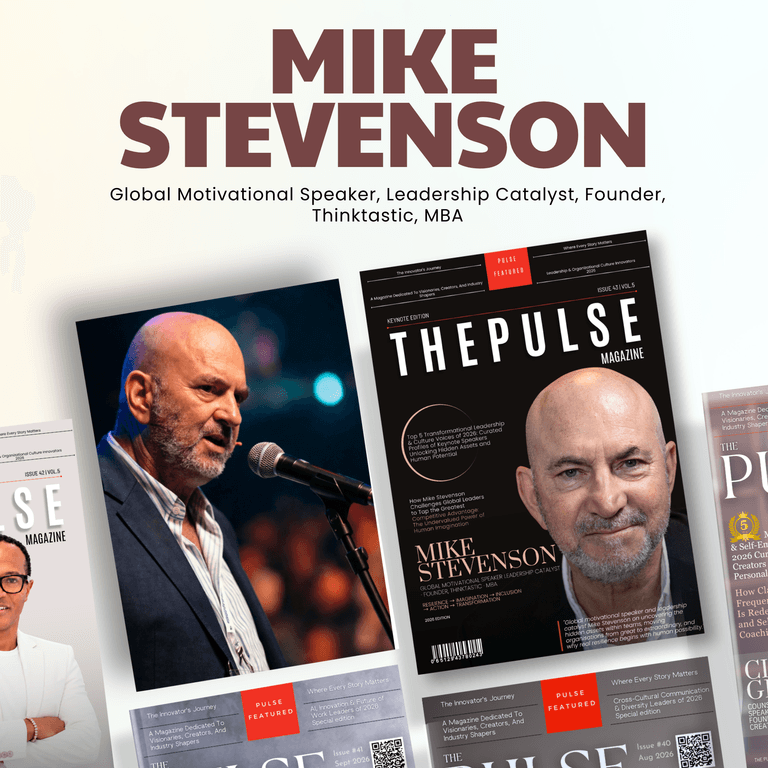
The Undervalued Power of Human Imagination: How Mike Stevenson is Redefining Label-Free Leadership
Global motivational speaker. Founder of Thinktastic. Executive catalyst who earned his MBA 43 years after being expelled from school. In this exclusive Pulse Magazine feature, Mike Stevenson reveals why true organizational resilience doesn't come from squeezing employees harder, but from unlocking the "hidden assets" already in the room. Drawing on his journey from sleeping rough in London to advising multinational boards, he explains why human imagination, not artificial intelligence remains the greatest competitive advantage in business today.
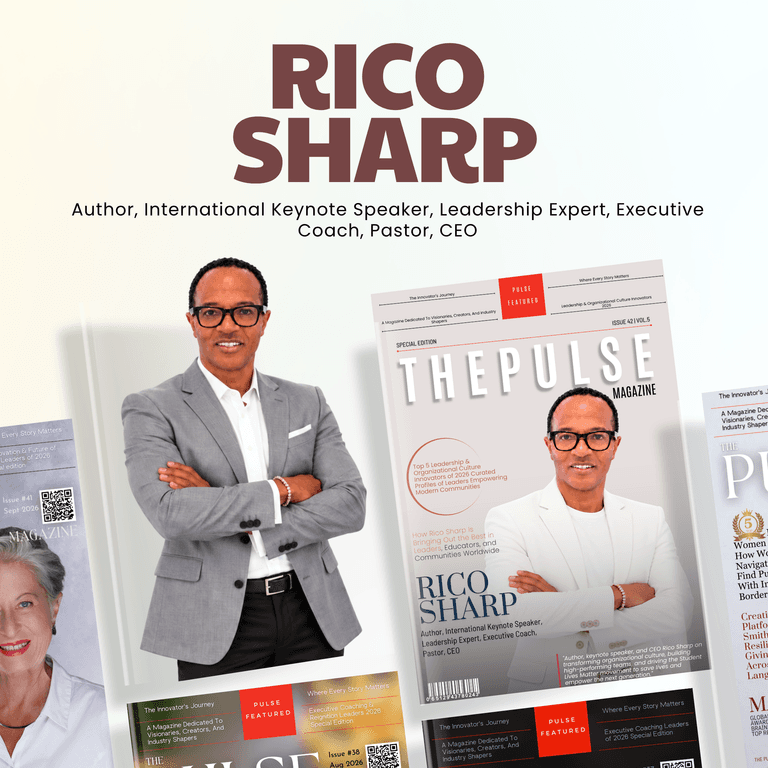
The WHO Factor: How Rico Sharp is Redefining Leadership and Organizational Culture
Author, international keynote speaker, and CEO. Beginning his transformational journey from a prison cell at age nineteen, Rico Sharp has spent three decades empowering leaders and communities worldwide. In this exclusive Pulse Magazine feature, Sharp reveals why organizations must hire for the "WHO" (character and integrity) rather than just the "WHAT" (credentials). He shares the philosophy behind his renowned leadership academies and explains how the Student Lives Matter movement is shifting the national paradigm from reactive crisis response to proactive violence prevention.

Augmenting Humanity: How Dr. CJ Meadows is Redefining Business Education for the AI Era
Harvard DBA. Author of 13 books. IDEO+ExperiencePoint-certified facilitator and innovation ecosystem builder. In this exclusive Pulse Magazine feature, Dr. CJ Meadows reveals why generative AI will not replace human leaders, but rather augment them to focus on what humans do best. Drawing on over three decades of consulting and teaching, she shares the design thinking philosophy shaping executives at S P Jain School of Global Management, and explains why true digital transformation is always 75% human work.