Restoring Momentum Through Clarity, Courage & Collaboration: The Leadership Journey of Leila Kubesch
A powerful exploration of Leila Kubesch’s leadership philosophy, focusing on clarity, courage, and collaboration as the foundation of modern, human-centered leadership.

Leila Kubesch on redefining leadership through clarity and collaboration
Introduction: Rethinking Leadership in a Changing World Leila Kubesch
There are moments in time when leadership is redefined not by trends, but by necessity. As organizations evolve in an era shaped by rapid technological advancement, cultural shifts, and increasing complexity, one truth becomes clear: leadership today is no longer about authority or control. It is about connection, clarity, and the ability to create meaningful momentum.
In this powerful edition of The Pulse Magazine, we explore a narrative that goes beyond surface-level success and dives into the philosophy of leadership that drives real transformation. This is not merely a story of professional achievement it is a reflection on how individuals lead through uncertainty, build trust, and create environments where people can thrive.
At the center of this journey is a leader whose work challenges conventional thinking and invites a new way forward.
The Journey of Leila Kubesch
A Leader Beyond Conventional Boundaries
Leila Kubesch is not defined by a single title. As a TEDx and international keynote speaker, and a recognized expert in workplace culture and communication, her work operates at the intersection of leadership, human behavior, and organizational transformation.
Her journey reflects a deep understanding that leadership is not about standing above others but about standing with them.
From aviation environments to corporate boardrooms and classrooms, Kubesch has consistently navigated complex human dynamics, uncovering a fundamental truth: organizations do not grow unless people grow.
From Communication to Connection
One of the most defining aspects of Kubesch’s work is her focus on communication not as a transactional tool, but as a transformational force.
As highlighted throughout the feature (particularly in the sections exploring communication breakdowns and leadership environments), she emphasizes that unclear communication does more than create confusion it can disrupt alignment, weaken trust, and ultimately impact performance.
Her approach shifts communication from:
- Delivering messages → to creating understanding
- Giving instructions → to building dialogue
- Managing teams → to empowering people
Leadership in Moments That Matter
Kubesch’s leadership philosophy is shaped not by theory, but by real-world environments where clarity is critical and mistakes carry consequences.
These experiences have taught her that:
- Leadership is tested in uncertainty
- Growth begins with discomfort
- And transformation starts with awareness
Rather than seeking control, she focuses on creating space for reflection, conversation, and shared understanding.
A Voice for Human-Centered Leadership
At the heart of her work lies a commitment to human-centered leadership an approach that prioritizes people over processes and connection over control.
She challenges leaders to ask:
- Are we truly listening?
- Are we creating space for others to contribute?
- Are we leading with intention or reacting to pressure?
These questions are not just reflective they are transformational.
The Follow: Leadership Philosophy & Transformational Insights
Clarity as the Foundation of Momentum
One of the most powerful insights from this edition is the redefinition of momentum.
Traditionally, momentum is associated with speed moving faster, doing more, achieving quickly.
But Kubesch presents a different perspective:
Momentum is not driven by speed.
It is driven by clarity.
As emphasized in the editorial note (page 3), real progress begins when leaders pause, reflect, and align their actions with purpose.
The Courage to Ask Better Questions
In a world that often rewards quick answers, Kubesch highlights the importance of asking better questions.
This philosophy is powerfully captured in the cover message:
“Leadership is no longer defined by the answers you give, but by the questions you dare to ask.”
This shift transforms leadership from:
- Authority → Inquiry
- Control → Curiosity
- Reaction → Reflection
And in doing so, it creates deeper engagement and more meaningful outcomes.
other central theme is collaboration not as a buzzword, but as a leadership necessity.
Kubesch emphasizes that:
- Innovation emerges from diverse perspectives
- Growth happens through shared dialogue
- And success is built collectively, not individually
Leaders who create environments of openness and inclusion enable teams to:
- Think freely
- Contribute authentically
- And perform at their highest potential
Communication: The Invisible Force of Leadership
Throughout the magazine, communication emerges as one of the most critical and often overlooked elements of leadership.
A powerful insight highlighted in the feature states:
Unclear communication doesn’t just slow systems down—in the wrong environment, it can cost lives.
This underscores the responsibility leaders carry not just to speak, but to ensure understanding.
Redefining Success in Leadership
Kubesch’s philosophy challenges traditional definitions of success.
Success is no longer:
- Just performance metrics
- Or short-term achievements
Instead, it becomes:
- The ability to create alignment
- The capacity to build trust
- The willingness to listen and adapt
This human-centered approach repositions leadership as a long-term, relational discipline, rather than a short-term transactional role.
The Power of Creating Space
One of the most profound ideas in this edition is the concept of “creating space.”
True leadership is not about dominating conversations but about enabling them.
Leaders must create space for:
- Ideas to emerge
- Voices to be heard
- Perspectives to be challenged
Because it is within this space that transformation begins.
Conclusion: Leadership That Moves People Forward
This feature is more than a profile it is a reflection on the evolving nature of leadership itself.
It reminds us that:
- Leadership is not about having all the answers
- It is about asking better questions
- It is not about speed
- It is about clarity
- It is not about control
- It is about connection
Leila Kubesch’s journey offers a powerful blueprint for modern leadership one that is grounded in humanity, strengthened by courage, and driven by collaboration.
Final Reflection
In a world that is constantly accelerating, the most impactful leaders are not those who move the fastest but those who move with intention.
Because in the end, leadership is not about leading louder.
It is about leading better.
FAQ
What is Leila Kubesch known for?
Leila Kubesch is known for her work in leadership, communication, and workplace culture, focusing on clarity, courage, and collaboration.
Why is clarity important in leadership?
Clarity helps leaders align teams, improve decision-making, and create meaningful progress in organizations.
What is human-centered leadership?
It is a leadership approach that prioritizes people, communication, and collaboration over rigid processes.
Connect with Leila Kubesch
If you would like to explore more of Leila Kubesch’s work, insights, or connect with her directly, you can follow and engage through her professional platforms:
Official Channels
- LinkedIn: linkedin.com/in/leila-kubesch
- Website: espeakers.com (Portfolio) leilakubesch.com (Company) kubesch photography (Company)
- Email: leilakubesch@gmail.com
- Speaking & Collaborations: Available for keynote speaking, leadership workshops, and organizational consulting
For Collaborations & Speaking Engagements
Leila Kubesch is known for her impactful work in:
- Leadership development
- Workplace culture transformation
- Communication and human-centered leadership
If you are an organization, institution, or event curator looking to bring meaningful conversations around leadership and communication, connecting with her can create powerful value.
Must Read The Pulse Journey
Related Stories
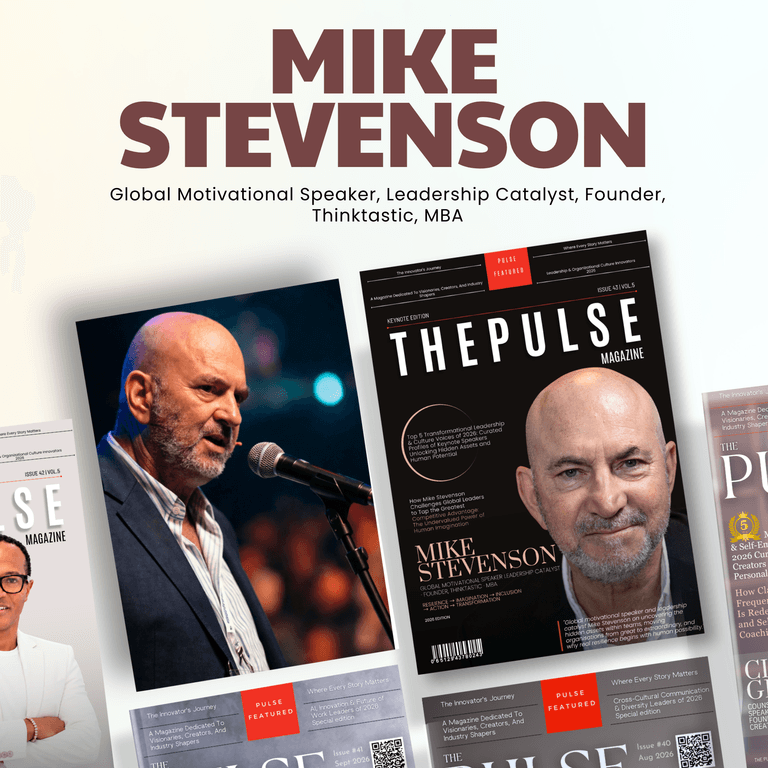
The Undervalued Power of Human Imagination: How Mike Stevenson is Redefining Label-Free Leadership
Global motivational speaker. Founder of Thinktastic. Executive catalyst who earned his MBA 43 years after being expelled from school. In this exclusive Pulse Magazine feature, Mike Stevenson reveals why true organizational resilience doesn't come from squeezing employees harder, but from unlocking the "hidden assets" already in the room. Drawing on his journey from sleeping rough in London to advising multinational boards, he explains why human imagination, not artificial intelligence remains the greatest competitive advantage in business today.
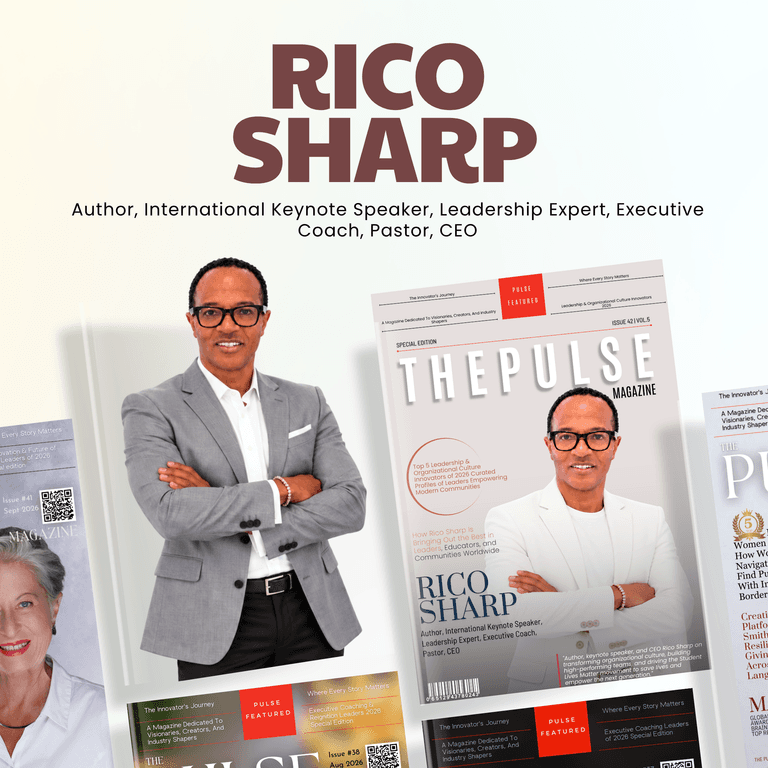
The WHO Factor: How Rico Sharp is Redefining Leadership and Organizational Culture
Author, international keynote speaker, and CEO. Beginning his transformational journey from a prison cell at age nineteen, Rico Sharp has spent three decades empowering leaders and communities worldwide. In this exclusive Pulse Magazine feature, Sharp reveals why organizations must hire for the "WHO" (character and integrity) rather than just the "WHAT" (credentials). He shares the philosophy behind his renowned leadership academies and explains how the Student Lives Matter movement is shifting the national paradigm from reactive crisis response to proactive violence prevention.

Augmenting Humanity: How Dr. CJ Meadows is Redefining Business Education for the AI Era
Harvard DBA. Author of 13 books. IDEO+ExperiencePoint-certified facilitator and innovation ecosystem builder. In this exclusive Pulse Magazine feature, Dr. CJ Meadows reveals why generative AI will not replace human leaders, but rather augment them to focus on what humans do best. Drawing on over three decades of consulting and teaching, she shares the design thinking philosophy shaping executives at S P Jain School of Global Management, and explains why true digital transformation is always 75% human work.