How Deborah Levine's Matrix Model Is Reshaping Cross-Cultural Communication and Emotional Intelligence
One month before September 11th, she founded a diversity council in a small Southern city. Then the towers fell, and dialogue was no longer enough. In this exclusive Pulse Magazine feature, Harvard-educated Forbes Trailblazer Deborah Levine reveals how that moment of crisis gave rise to the Matrix Model — a cross-cultural framework now used at Fortune 500 corporations and international AI conferences. She shares why storytelling, not policy or research, is the technology that actually builds cross-cultural intelligence, and why restoring our humanity across difference is no longer optional.

Some careers defy summary. Deborah Levine's is unequivocally one of them. A Harvard Radcliffe education in Folklore and Mythology. A documentary that has screened in sixteen international film festivals. Twenty published books spanning memoir, Holocaust education, children's literature, and leadership methodology. The Matrix Model Management System, invented in the aftermath of September 11th and now being presented at international AI conferences. Nineteen years of editorial leadership at the American Diversity Report. A Baroque Dance Company. A father who was a Ritchie Boy.
Beneath all of this extraordinary output runs a single, sustained conviction: that storytelling is the most powerful technology available to human beings for the work of understanding across difference. And that understanding across difference is the most urgent challenge facing human beings right now.
In an era marked by rapid globalization, technological disruption, and rising cultural polarization, the need for leaders equipped with genuine cultural intelligence has never been greater. Named a Forbes Trailblazer, Deborah Levine has dedicated her five-decade career to ensuring that the tools for cross-cultural empathy are not just theoretical concepts, but practical, deployable frameworks. Through her work featured in The Pulse Magazine, we explore how Levine's groundbreaking methodologies are helping people navigate difference—and why it all starts with listening.
The Matrix Model Management System: A Cognitive Innovation Born from Crisis
One month before the September 11th attacks, Deborah Levine had founded the Women's Council on Diversity in Chattanooga, Tennessee. The diverse cultures of this small Southern city lived in uncomfortable proximity without meaningful exchange. The Council had been using storytelling to develop speaking and listening skills. But when the towers fell, dialogue was no longer enough. The attacks made urgent what had previously been merely important. The community needed not just conversation, but a common language and a framework for decision-making under intense pressure.
What Levine designed in that period of urgency became the Matrix Model Management System. Thirty-five years of application across organizations, leadership programs, interfaith coalitions, and educational institutions has proven its durability. Today, it is being presented at international AI conferences, applied in Fortune 500 corporations, and refined to train AI systems themselves in cross-cultural intelligence.
The name is chosen with precision. Matrix Algebra is the mathematical foundation of computer programming—a system for processing multiple simultaneous relationships without collapsing their complexity. Levine chose it because it reflects the genuine nature of cross-cultural communication. It is not a linear journey from misunderstanding to understanding, but a multi-dimensional system that must be held whole.
The framework is grounded in two deep intellectual traditions. The first is the cultural anthropology of Claude Lévi-Strauss, who understood culture as a deep structure of meaning rather than a collection of surface habits. The second is the pioneering neurodiversity work of her mother, who published research in a 1940s Yale academic journal and applied those insights by reading Victorian folk tales to a toddler who would begin reading at age two.
Most cross-cultural communication training addresses the surface of cultural difference: customs, greetings, dietary rules, and calendar sensitivities. While valuable, this surface-level training does not produce the cognitive flexibility required for genuine cross-cultural leadership. The Matrix Model works at a deeper level. It develops the capacity to hold multiple cultural frameworks simultaneously and to make decisions genuinely informed by that structural understanding. It produces leaders who can function effectively in genuinely complex cross-cultural environments.
The Thread That Runs Through Everything: Storytelling as Cognitive Architecture
Forbes named Deborah Levine a Trailblazer. She has written twenty published books. Her work spans children's literature, Holocaust education, leadership methodology, interfaith dialogue resources, and memoir. While the breadth of this output seems to belong to multiple different careers, the thread that connects all of it is storytelling.
Levine understands storytelling not as a craft, but as a cognitive technology. It is the mechanism through which human beings have always built shared understanding, transmitted cultural values, and developed the capacity to see from perspectives not their own. Her early formation—reading at age two, majoring in Folklore and Mythology at Radcliffe-Harvard—was a scientific interest in how narrative functions as a tool for cognitive and cultural development.
Stories do something that research, policy, and training cannot do. They bypass the cognitive defenses that direct communication inevitably triggers. When someone is placed inside a narrative that requires them to imaginatively and emotionally inhabit a different perspective, the shift happens below the threshold of resistance. Stories build neural nets that absorb new cultural understanding and new emotional contexts. They create real, temporary experiences of being someone else.
Levine lives with hyperthymesia, a rare neurological condition that enables her to put herself into memories as if they are the present. For Levine, the past is not a reconstruction but a re-entry. When health issues forced a hiatus from executive roles, writing became a survival mechanism. The stories produced during those periods carry a seriousness of witness and a refusal of comfortable distance.
"Storytelling does something that research, policy, and training cannot. It bypasses the defences—it creates a real, temporary experience of being someone else."
The Liberator's Daughter: Carrying a Father's Witness
Deborah Levine first learned about her father's wartime letters when she was working as the Media and Community Coordinator for Tulsa's Jewish Federation, shortly after the Oklahoma City bombing. She was dealing with neo-Nazis and Holocaust deniers in her professional capacity when she discovered her father's private inheritance of witness.
Her father was a Ritchie Boy, a US military intelligence officer assigned to interrogate Nazi POWs in World War II. Mostly European Jewish refugees who had fled Nazi persecution, the Ritchie Boys were recruited for their language skills and cultural knowledge. They were uniquely positioned witnesses who bore the full weight of personal history alongside their professional assignments.
The letters took years to read. They were so emotional that Levine approached them gradually before including them in her memoir, The Liberator's Daughter. The process of allowing herself to fully receive what her father had witnessed was a form of testimony. This eventually led to a radio show and the documentary Untold, Stories of a World War II Liberator, which has screened in sixteen international film festivals.
The urgency of Holocaust education in 2026 is an observable reality. Antisemitism is rising, and Holocaust denial is amplified by digital technologies. As the generation of direct witnesses passes, documentation and testimony must continue to speak. Levine's use of technology to extend her father's witness ensures that stories reach younger generations in the formats they actually engage with.
Bridges Across Belief: Thirty Years of Transformative Interfaith Work
Levine's interfaith work began in childhood on the island of Bermuda, where she was the only Jewish little girl attending an Anglican school. Navigating religious difference from the position of a solitary minority faith representative was her first cross-cultural education. She learned to read unspoken assumptions and understand what genuine religious literacy feels like from the receiving end.
She later brought this embodied knowledge to her role as Director of Interreligious Affairs for the American Jewish Committee. When health issues required her to leave, she founded the DuPage Interfaith Resource Network in an increasingly diverse Chicago suburb. The network brought together representatives of seventeen or more faith traditions in genuine, sustained dialogue.
Levine distinguishes between polite interfaith engagement, which maintains comfortable distance, and transformative engagement, which creates real encounters across differences. The prerequisite for genuine engagement is religious literacy. It is not about theological agreement, but basic knowledge of traditions and practices. When a faith community discovers its dialogue partner does not know basic facts about their tradition, trust is damaged. Over thirty years, Levine has shown that communities most committed to genuine dialogue are often those who have the most at stake in its failure.
Teaching the Machine to Listen: AI and the Edge of Chaos
When Levine was asked to present the Matrix Model at an international AI conference, the organizers knew it was an unexpected intersection. AI conferences are not typically venues for presentations on cross-cultural emotional intelligence. But the need for cross-cultural intelligence in AI development is a foundational concern.
AI systems learn from data that reflects the cultures and implicit assumptions of its curators. An AI trained predominantly on English-speaking, Western data will produce outputs that reflect those contexts. When deployed globally, the outputs can be systematically wrong culturally. Levine's work with AI companies, including consulting for Outlier AI, addresses this problem.
She works to ensure training data reflects genuine global diversity, utilizing the Matrix Model to understand how different cultural frameworks structure meaning. She also trains the human professionals developing AI systems engineers and computer scientists in cross-cultural communication. It is a professional requirement for teams building systems for diverse global users.
Her most illuminating AI application is Bunny Bear Adventures in Diversity Land, a series of AI-generated children's video stories and coloring books. It demonstrates that AI, guided by deep cross-cultural understanding, can create highly effective educational resources. While AI can process cultural differences, it cannot develop genuine empathy. The capacity to be actually affected by someone different from yourself is irreducibly human.
As a futurist, Levine understands that the most generative environment for new capabilities is at the "edge of chaos." While many leaders try to manage their way back to familiar stability during chaotic times, surviving organizations are those willing to experiment and create something new. The current moment of cultural and technological chaos makes this capability more urgent than ever.
"The most creative place on the planet is at the edge of chaos. We are there now... The futurist's job is to help leaders understand that the creativity available at this edge is the asset, not the threat."
The American Diversity Report: 19 Years of Witness and Resilience
The American Diversity Report began as a PDF newsletter for the Women's Council on Diversity. It eventually expanded into a worldwide platform, running successfully until it was attacked and crashed by antisemitic actors. This act of digital violence was a direct confrontation with the forces whose power to harm the platform's existence was one of its reasons for existing in the first place.
Levine rebuilt it into a global writers' colony. The focus expanded to include climate change, healthcare, education, artificial intelligence, and international commerce, recognizing that diversity is a fundamental dimension of every significant societal challenge. Today, its LinkedIn Group, Global Leaders of the 21st Century, has over five thousand members. In nineteen years, the American Diversity Report has outlasted multiple political cycles, proving that the genuine appetite for cross-cultural intelligence resides in communities and individuals seeking practical competence, regardless of corporate or institutional trends.
Methodology Breakdown: Core Pillars of Levine's Cross-Cultural Framework
Levine's cognitive frameworks operate on several interconnected foundational principles:
- Religious Literacy First: Mistakes in small things—dietary rules, holidays, unexamined assumptions—cause a critical loss of trust. Establishing basic literacy is an absolute prerequisite before entering dialogue.
- Narrative Intervention: Utilizing storytelling to bypass cognitive defenses. Stories build neural nets that absorb new information, creating real experiences of being someone else.
- Embodied Knowledge (The Arts): Recognizing that culture is transmitted through movement and ritual. The performing arts open doors to other cultures in ways that invite you in, bypassing intellectual arguments entirely.
- Operating at the Edge of Chaos: Embracing dynamic instability as a generative environment for creativity, rather than retreating to obsolete models of stability.
- Carrying the Witness: Ensuring historical documentation and memory—like her father's WWII letters—survive and reach new generations through accessible formats and technology.
Actionable Takeaways for Organizational Leaders
- Surface-Level Training is Insufficient: Memorizing cultural greetings and holidays is helpful but inadequate. Leaders must adopt deep structural frameworks, like the Matrix Model, to process multiple cultural variables simultaneously during high-pressure decision-making.
- AI Demands Human Wisdom: AI technologies must be backed by human cross-cultural intelligence. Without it, organizations risk scaling cultural imperialism and bias at machine speed.
- Leadership is Influence, Not Control: Effective organizational leadership demands the ability to shape culture, manage change with empathy, and inspire people toward a shared vision. A healthy culture improves retention, satisfaction, and long-term capability.
- Inspire and Instruct: Inspiration without instruction lacks practical skill; instruction without inspiration lacks sustained commitment. The combination of both is required to build genuine trust across deep differences.
Restoring Our Humanity
When Deborah Levine speaks about the stakes of failing to build cross-cultural bridges, she does not use corporate jargon. She speaks of humanity. Restoring our humanity requires more than good intentions; it requires the cognitive and emotional capabilities to hold cultural complexity without collapsing it.
What specific cultural variables could your organization better address by adopting a multidimensional, storytelling-based framework today?
Certificate of Recognition
Dedicated to Deborah Levine
The Pulse Magazine is proud to honor Deborah Levine, Forbes Trailblazer, Harvard-affiliated author of 20 books, Holocaust educator, and creator of the Matrix Model with our Outstanding Achievement Award for Excellence in Cross-Cultural Communication & Diversity Leadership.
Deborah's Matrix Model has given countless people a way to navigate difference with empathy and emotional intelligence. Her decades of work as a storyteller and Holocaust educator continue to build bridges of understanding across faiths and cultures, proving that real change starts with listening.
"Navigating difference starts with listening." - Deborah Levine
Congratulations, Deborah, on this well-deserved recognition.

Read more from The Pulse Magazine: thepulsemagazines.com | Follow us on LinkedIn and Instagram @thepulsemagazines
Related Stories
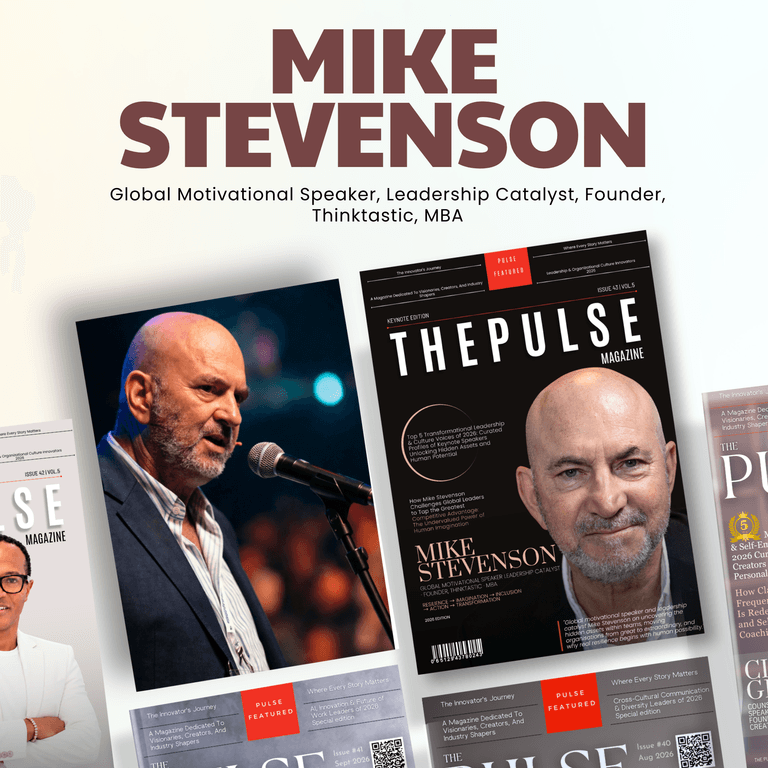
The Undervalued Power of Human Imagination: How Mike Stevenson is Redefining Label-Free Leadership
Global motivational speaker. Founder of Thinktastic. Executive catalyst who earned his MBA 43 years after being expelled from school. In this exclusive Pulse Magazine feature, Mike Stevenson reveals why true organizational resilience doesn't come from squeezing employees harder, but from unlocking the "hidden assets" already in the room. Drawing on his journey from sleeping rough in London to advising multinational boards, he explains why human imagination, not artificial intelligence remains the greatest competitive advantage in business today.
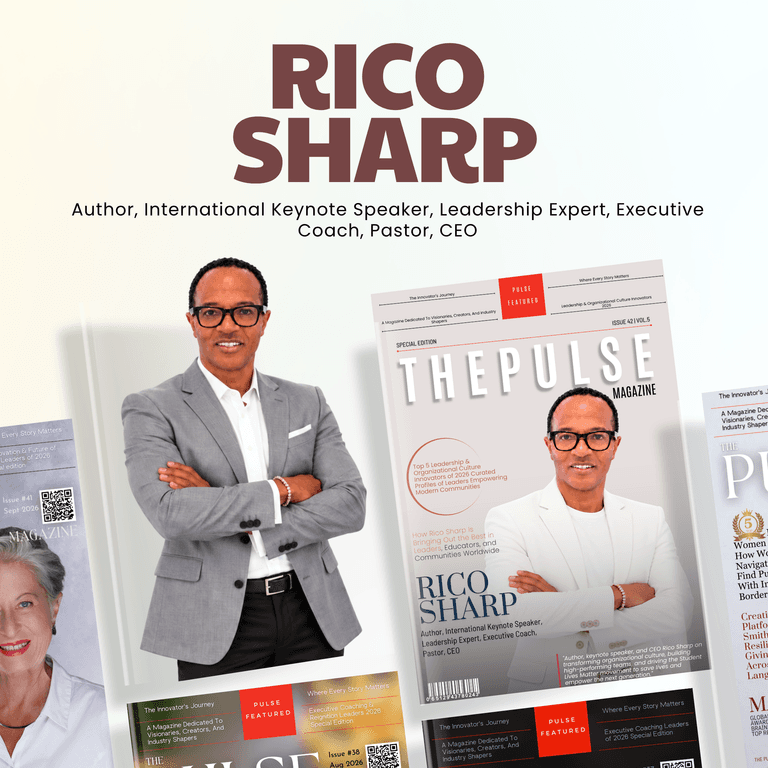
The WHO Factor: How Rico Sharp is Redefining Leadership and Organizational Culture
Author, international keynote speaker, and CEO. Beginning his transformational journey from a prison cell at age nineteen, Rico Sharp has spent three decades empowering leaders and communities worldwide. In this exclusive Pulse Magazine feature, Sharp reveals why organizations must hire for the "WHO" (character and integrity) rather than just the "WHAT" (credentials). He shares the philosophy behind his renowned leadership academies and explains how the Student Lives Matter movement is shifting the national paradigm from reactive crisis response to proactive violence prevention.

Augmenting Humanity: How Dr. CJ Meadows is Redefining Business Education for the AI Era
Harvard DBA. Author of 13 books. IDEO+ExperiencePoint-certified facilitator and innovation ecosystem builder. In this exclusive Pulse Magazine feature, Dr. CJ Meadows reveals why generative AI will not replace human leaders, but rather augment them to focus on what humans do best. Drawing on over three decades of consulting and teaching, she shares the design thinking philosophy shaping executives at S P Jain School of Global Management, and explains why true digital transformation is always 75% human work.