The Undervalued Power of Human Imagination: How Mike Stevenson is Redefining Label-Free Leadership
Global motivational speaker. Founder of Thinktastic. Executive catalyst who earned his MBA 43 years after being expelled from school. In this exclusive Pulse Magazine feature, Mike Stevenson reveals why true organizational resilience doesn't come from squeezing employees harder, but from unlocking the "hidden assets" already in the room. Drawing on his journey from sleeping rough in London to advising multinational boards, he explains why human imagination, not artificial intelligence remains the greatest competitive advantage in business today.
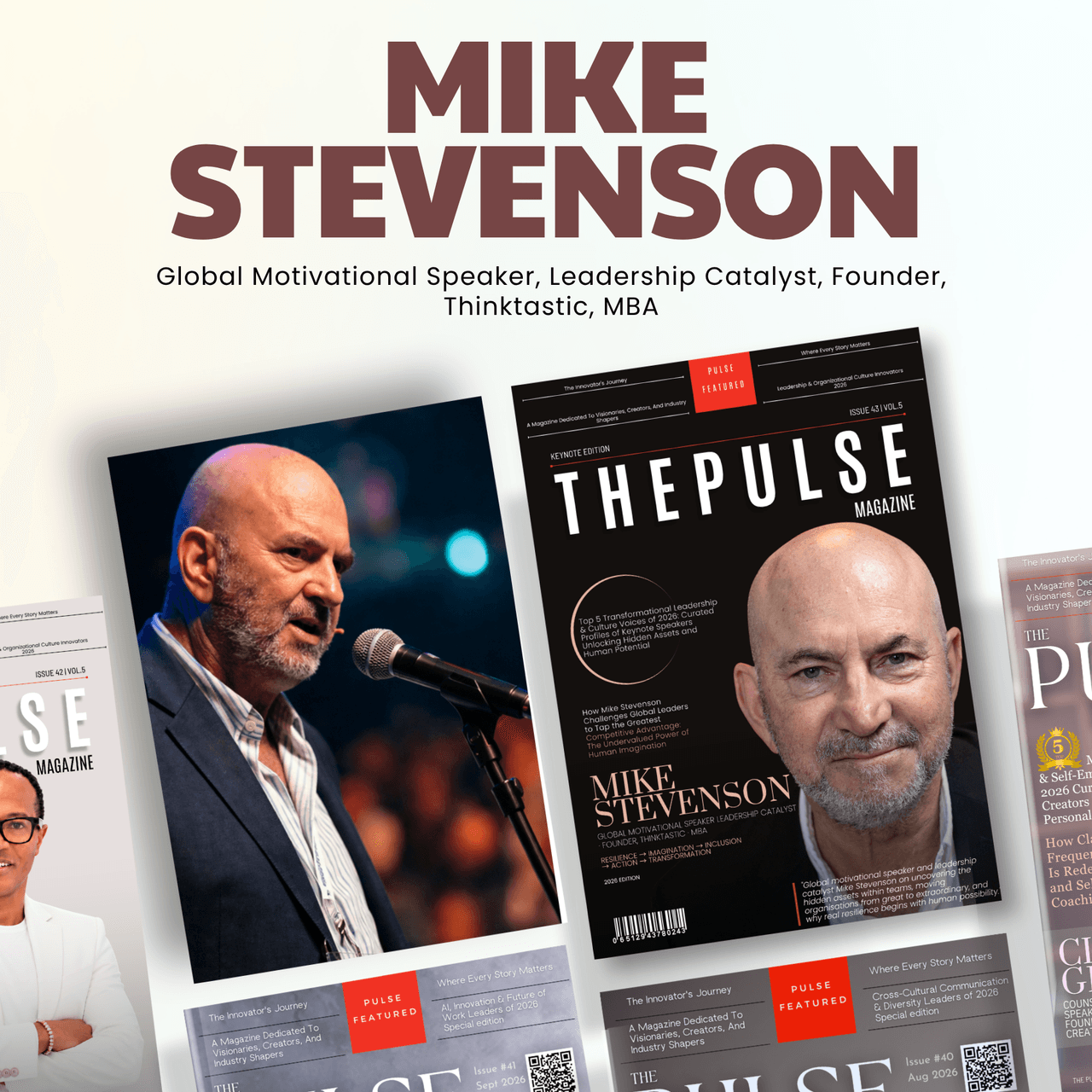
There is a version of the entrepreneurial underdog story that is incredibly easy to tell. It usually involves a protagonist overcoming immense hardship, pulling themselves up by their bootstraps, and using their trauma as the ultimate character-building tool to achieve monumental corporate success. Mike Stevenson, a global motivational speaker and leadership catalyst, categorically refuses to tell his story that way.
Expelled from school at fifteen, sleeping rough on the cold streets of London at sixteen, and cycling through nearly thirty jobs by his mid-twenties—including busking in Dublin and packing boxes in a biscuit factory—Stevenson’s early life was marked by severe adversity. On paper, by every standard metric HR departments use today, he was exactly the kind of young man society is conditioned to write off.
But Stevenson is fiercely adamant that poverty is not character-building when it systematically crushes hope and opportunity. Instead of a romanticized survival narrative, he offers a profound organizational mechanism: his hardship gave him an unparalleled eye for the capabilities that conventional corporate systems routinely miss. Today, as the founder of Thinktastic and a highly sought-after advisor for giants like AstraZeneca and Aviva, he is actively challenging global executives to tap their greatest competitive advantage: the undervalued power of human imagination.
The Crucible of Resilience: Uncovering the "Hidden Assets"
When Mike Stevenson walks into a stagnant corporate culture, he does not immediately look at financial dashboards, strategic planning documents, or organizational charts. He looks for the people whose contributions have been systematically edited out of the official picture. He frequently states that most organizations do not have a people problem; they have a "Hidden Assets" problem.
During his years on the margins, Stevenson met individuals with extraordinary ingenuity, profound loyalty, and survival skills that would put corporate risk managers to shame. Yet, these individuals would never have described themselves as talented because nobody had ever invited them to the table. Labels, he argues, are lazy substitutes for genuinely understanding people. The societal habit of categorizing individuals based on their lowest moments blinds organizations to the raw, untapped potential sitting right in front of them.
He illustrates this with the parable of the broken lamp. While working with a housing association, a senior manager warned Stevenson about a frontline worker labeled as "trouble." In a collaborative session, this employee emerged as the most thoughtful and empathetic contributor. His frustration stemmed from being blocked by bureaucratic rules from doing small, meaningful things for older tenants—like changing a broken lightbulb for an elderly woman who loved to read. The system saw a boundary violation; the employee saw a human being in need. When organizations enforce rigid silos and prioritize compliance over compassion, they actively suppress the natural human instinct to solve problems.
“Labels are frequently lazy substitutes for genuinely understanding people. Leaders unlock immense value when they create the psychological room for people to speak candidly, act autonomously, and experiment boldly.”
Human Imagination vs. Artificial Intelligence
In an era increasingly obsessed with artificial intelligence, algorithmic strategy, and data-driven automation, Stevenson stands as a fierce champion of human imagination. While acknowledging the immense power of new technologies to release human workers from repetitive labor, he provides a vital corrective to the narrative that AI will render human strategic thinking obsolete.
Artificial intelligence is trained entirely on what already exists; it synthesizes the past to predict the future. Human imagination, by stark contrast, allows us to picture what does not yet exist. A machine can effortlessly produce a hundred strategic options based on historical data, but it cannot supply the purpose to choose the right one, the courage to execute an unpopular vision, or the moral compass to ensure the decision benefits society.
The competitive advantage of the future will not simply be having access to AI—soon, every organization will have these tools. The true advantage will belong to organizations whose people are curious enough to ask provocative questions, confident enough to challenge systemic assumptions, and humane enough to deeply understand long-term consequences. Stevenson champions technological synergy, where AI serves to exponentially enlarge human possibility, rather than encouraging lazy leaders to outsource their strategic thinking.
Scaling Enterprise: The Five-Year-Old Test and Radical Inclusion
Over twenty years, Stevenson built Design Links—later renamed Thinktastic—into a powerhouse consultancy. He also grew The Wise Group from four to 600 people, proving that rapid scale is possible without losing the soul of the business.
This legacy was built on radically simple pillars. The first is radical inclusion. If leadership truly wants the whole picture of an organization, they cannot invite only the people with impressive titles to the strategy table. The cleaners, frontline staff, and dissenting voices often hold the missing pieces of the puzzle.
The second is absolute clarity, famously applied through his "five-year-old test." Corporate environments frequently use jargon-heavy language to make ordinary problems appear untouchable, protecting the status of experts. Stevenson argues that if an intelligent five-year-old cannot grasp the central idea of a strategy, the leadership probably has not understood it themselves. Clarity removes fear and democratizes understanding.
The third pillar is imagination applied with distinct purpose. Creativity is not a theoretical exercise for away-days; it is a rigorous tool used to solve live operational problems, improve the customer experience, and reduce systemic waste. Imagination without purpose is daydreaming, but imagination tethered to a strategic goal is the engine of commercial growth.
Losing Everything and the Courage to Rebuild
The narrative of continuous, unbroken success is a dangerous myth in leadership. Stevenson achieved immense success, but he also experienced the catastrophic reality of losing his business empire and his home during the global financial crash. He refuses to apply a heroic gloss to this experience, noting that loss is profoundly disorientating and violently disrupts a person’s sense of identity.
Through this collapse, he learned to separate failure from personal worth. The failure of a commercial enterprise does not mean the human being at the helm is fundamentally flawed. He allowed himself to grieve but refused to let a bank’s balance sheet write the final paragraph of his life story.
Rebuilding was not a cinematic leap back to the top; it was an agonizingly slow series of resilient, small acts. It required swallowing pride, noticing small opportunities, and having the courage to accept help. The man who emerged from the crisis was fundamentally different—less impressed by the illusion of invulnerability and infinitely more compassionate. True resilience, Stevenson teaches, is not bouncing back to the exact person you were before the tragedy; sometimes, it is allowing the fire to transform you into someone entirely new.
Intelligent Economics with a Human Return
Stevenson’s work forcefully dismantles the illusion that business operates in a vacuum. As Chair of the Scottish Design Exchange (SDX), he pioneered a revolutionary retail model that bypassed traditional gatekeepers, empowering local artists and makers to retain the full revenue from their sales. Weaving social enterprise into commercial ventures is not a PR strategy; it is intelligent economics.
He argues that profit is a mechanism, not the complete purpose of an organization. When financial investment is directed toward developing people just as aggressively as it develops property—as seen in his early work with Heatwise—the entire local economy thrives. Social purpose sharpens commercial intelligence by keeping leadership close to frontline realities, uncovering unused infrastructure and overlooked talent.
“Head and heart are not rival departments competing for budget. The absolute best, most enduring leadership puts them collaboratively in the exact same room.”
Methodology Breakdown: Core Pillars of Label-Free Leadership
Stevenson’s signature framework—Resilience, Imagination, Inclusion, Action, Transformation—translates into highly actionable methodologies:
- Dismantling Labels: Refusing to categorize employees by their lowest moments or lack of credentials. Looking beyond the organizational dashboard to find "Hidden Assets" on the front lines.
- The Five-Year-Old Test: Forcing absolute clarity in strategic communication to ensure every level of the organization can align behind a comprehensible vision.
- Psychological Infrastructure: Making it safe for employees to question the status quo, offering modest resources for small experiments, and treating unsuccessful trials as vital empirical evidence rather than failure.
- Bridging the Spreadsheet and the Story: Merging rigorous data with deep emotional intelligence and lived experience. Recognizing that metrics explain what is happening, but empathy explains what it means.
Actionable Takeaways for Executive Leaders
- Stop Squeezing, Start Releasing: You do not move an organization from good to extraordinary by demanding more compliance. You do it by releasing the immense capacity already hidden in plain sight.
- Empower Human Imagination Over AI Reliance: Use AI to process the past, but fiercely protect human imagination to design the future. The competitive edge lies in moral courage and analogical reasoning.
- Redefine Resilience: Stop expecting employees to silently endure increasing corporate weight. Build environments where resilience means finding strategic meaning and forging alternative routes forward.
- Widen the Invitation: If you want to understand the reality of your company, bring the people who are normally excluded into the room. The best insights rarely come from the C-suite echo chamber.
Forging a Future Built on Human Possibility
Mike Stevenson’s journey from sleeping rough to advising multinational boards is not just a personal triumph; it is a definitive blueprint for cultural transformation. Earning his MBA forty-three years after expulsion, he proved that where you start does not dictate where you finish. The future will not be secured by the leader making the loudest claim to absolute certainty, but by those courageous enough to look again and give human imagination the practical power to change the world.
About This Special Edition
This deep-dive feature is a cornerstone of The Pulse Magazine’s Transformational Leadership 2026 Executive Spotlight. As a publication dedicated to the visionaries, creators, and industry shapers defining tomorrow’s global enterprise, we believe that true innovation stems from unearthing the hidden assets within our communities. Mike Stevenson’s label-free leadership model perfectly embodies our commitment to stories that challenge the status quo and elevate human potential. We invite you to explore the rest of this special edition to discover more actionable blueprints for building resilient, imagination-driven organizations.
Read more from The Pulse Magazine: thepulsemagazines.com | Follow us on LinkedIn and Instagram @thepulsemagazines
Related Stories
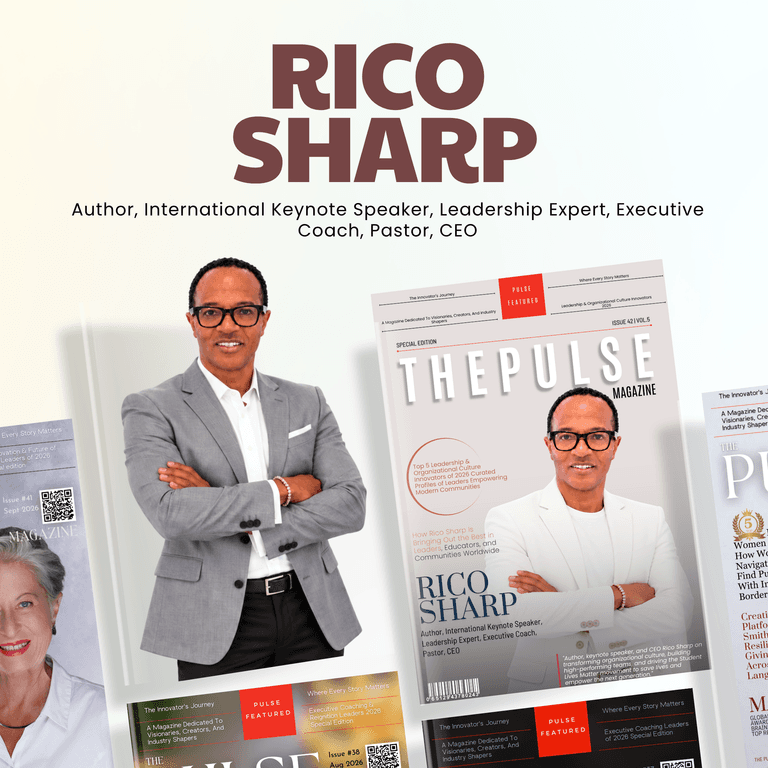
The WHO Factor: How Rico Sharp is Redefining Leadership and Organizational Culture
Author, international keynote speaker, and CEO. Beginning his transformational journey from a prison cell at age nineteen, Rico Sharp has spent three decades empowering leaders and communities worldwide. In this exclusive Pulse Magazine feature, Sharp reveals why organizations must hire for the "WHO" (character and integrity) rather than just the "WHAT" (credentials). He shares the philosophy behind his renowned leadership academies and explains how the Student Lives Matter movement is shifting the national paradigm from reactive crisis response to proactive violence prevention.

Augmenting Humanity: How Dr. CJ Meadows is Redefining Business Education for the AI Era
Harvard DBA. Author of 13 books. IDEO+ExperiencePoint-certified facilitator and innovation ecosystem builder. In this exclusive Pulse Magazine feature, Dr. CJ Meadows reveals why generative AI will not replace human leaders, but rather augment them to focus on what humans do best. Drawing on over three decades of consulting and teaching, she shares the design thinking philosophy shaping executives at S P Jain School of Global Management, and explains why true digital transformation is always 75% human work.

How Deborah Levine's Matrix Model Is Reshaping Cross-Cultural Communication and Emotional Intelligence
One month before September 11th, she founded a diversity council in a small Southern city. Then the towers fell, and dialogue was no longer enough. In this exclusive Pulse Magazine feature, Harvard-educated Forbes Trailblazer Deborah Levine reveals how that moment of crisis gave rise to the Matrix Model — a cross-cultural framework now used at Fortune 500 corporations and international AI conferences. She shares why storytelling, not policy or research, is the technology that actually builds cross-cultural intelligence, and why restoring our humanity across difference is no longer optional.