Augmenting Humanity: How Dr. CJ Meadows is Redefining Business Education for the AI Era
Harvard DBA. Author of 13 books. IDEO+ExperiencePoint-certified facilitator and innovation ecosystem builder. In this exclusive Pulse Magazine feature, Dr. CJ Meadows reveals why generative AI will not replace human leaders, but rather augment them to focus on what humans do best. Drawing on over three decades of consulting and teaching, she shares the design thinking philosophy shaping executives at S P Jain School of Global Management, and explains why true digital transformation is always 75% human work.
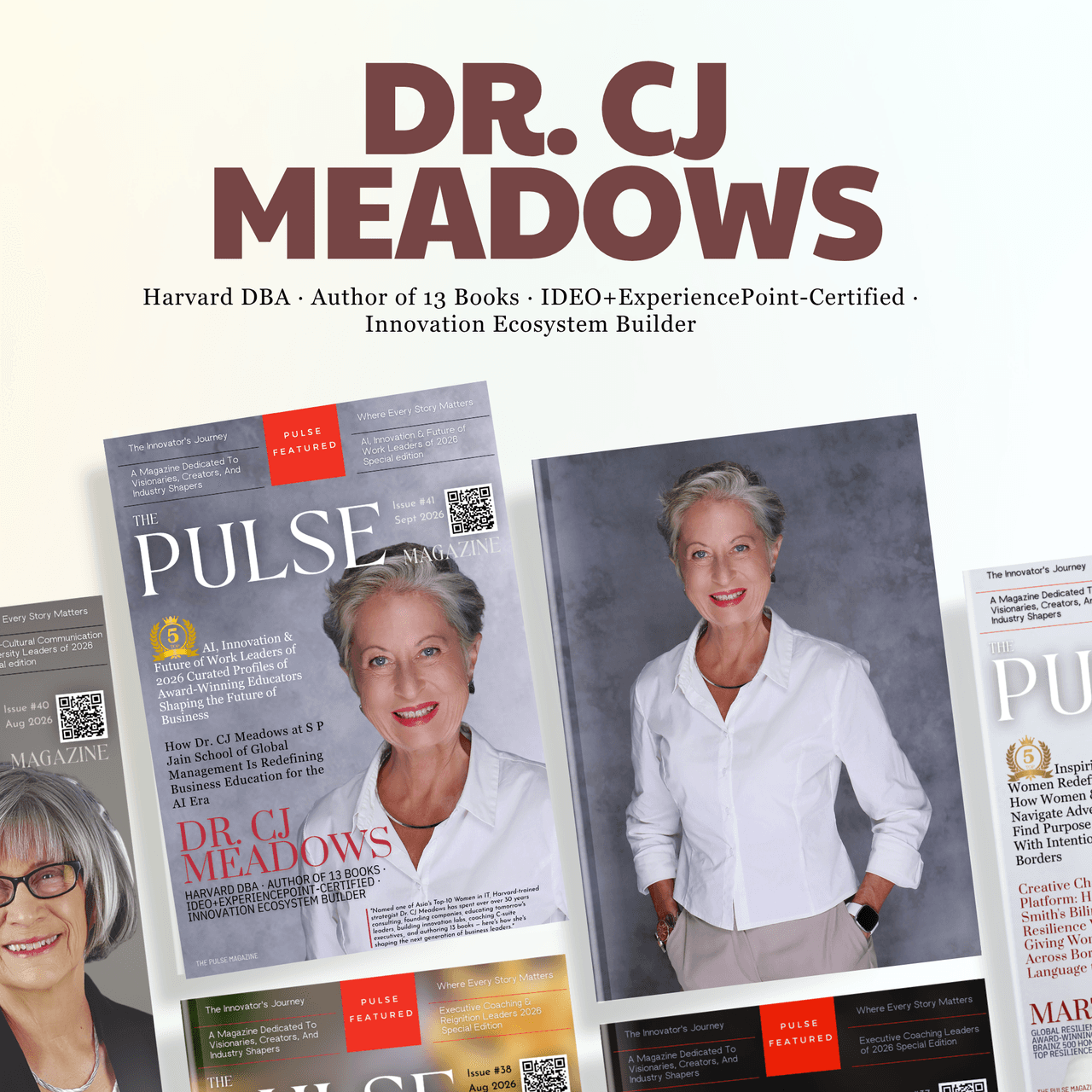
There is an easy, predictable version of the artificial intelligence narrative, and Dr. CJ Meadows refuses to accept it. With a Doctorate in Business Administration and IT from Harvard Business School, over three decades at the bleeding edge of enterprise technology, thirteen published books, and a custom-built digital twin to scale her influence, her resume reads like a tech-utopian dream. Yet, instead of celebrating the algorithm’s triumph over human capacity, she offers a profound correction: technologies do not make change; people do.
Artificial intelligence, in her view, is not here to make us robotic, it is here to free us from being machine cogs so that we can finally focus on what humans do best.
In an era defined by rapid technological shifts and existential anxieties about the future of work, Dr. Meadows stands as a vital bridge between human-centric empathy and high-stakes corporate strategy. As the Director of the Innovation & Entrepreneurship Centre at S P Jain School of Global Management and a certified IDEO+ExperiencePoint facilitator, she is actively architecting the next generation of global business leaders. Here is how Dr. Meadows is redefining legacy, innovation, and leadership for the AI era.
The Human Element of Technological Disruption
When the conversation turns to the disruptive power of generative AI, Dr. CJ Meadows often reaches back to Henry Ford. In 1941, Ford built an automobile with bio-plastic panels that ran on biofuel. It was a marvel of innovation—yet it did not change the world. Similarly, artificial intelligence has existed since the 1950s but spent seven decades waiting for its tipping point.
Why didn’t these breakthroughs immediately revolutionize the world? For Dr. Meadows, the answer forms the bedrock of her professional worldview: technologies must have accessible interfaces, a supportive ecosystem, and crucially, people must actually want to change.
She witnessed this dynamic firsthand during her early research into global virtual teams in the 1990s. She predicted that services would globalize just as manufacturing had, but the transformation stalled. The idea was correct, but the conditions were not present—Skype and Zoom had not yet launched, and global workforces had not yet been forced to adapt by a pandemic. This deep historical awareness allows Dr. Meadows to navigate the current AI landscape with pragmatic optimism. She advises leaders to expect the over-hype and anticipate the inevitable bust, while strategically positioning themselves to capitalize on the enduring value that will surface once the technology truly aligns with human needs.
From Consulting Trenches to the Architecture of Innovation
Dr. Meadows’s architectural rigor was not forged in an ivory tower; it was built on the front lines of global enterprise consulting. Beginning her career at Accenture, she built highly secure, mission-critical systems for the US Government before transitioning to strategic leadership for financial services across Asia. Through pivotal roles at Scient Corp, Praxis Research, and MMA Consulting, she learned a hard truth: the most beautiful visions and shiny technologies will go nowhere without the right people, structures, and systems to execute them.
Corporate change is rarely a purely rational process. Dr. Meadows observed that decisions are often made for emotional reasons, shaped by office politics and structural silos where information and power rarely align. She realized that digital transformation is essentially 25% technology work and 75% human work.
This realization fundamentally altered her trajectory, driving her to pursue her Harvard DBA to find rigorous frameworks that explained these behavioral anomalies. Today, she teaches executives that to successfully build the future, they must master a dual literacy: comprehending the absolute limits of technology while navigating the complex psychology of how humans work together.
“You may have the best strategy and technology in the world, but without people who can make it happen—and want to... your beautiful visions and shiny new technology will go nowhere.”
Design Thinking and the Innovation & Entrepreneurship Centre
At the S P Jain School of Global Management, Dr. Meadows has engineered an unprecedented ecosystem of innovation. Over the past 12 years, she has built an infrastructure that includes elite executive education partnerships with Harvard Business Online, IBM Garage, and IDEO+ExperiencePoint, alongside consulting supervision for titans like Google, Microsoft, and Samsung.
Central to this ecosystem is the application of design thinking. Traditional strategic planning relies on a top-down, inside-out approach suited for highly competitive "red oceans." In contrast, design thinking is a bottom-up, outward-in, user-first ethos designed for "blue-ocean" scenarios, uncharted territories where no market currently exists.
Dr. Meadows guides executives to shift from merely leading delivery to leading discovery. She designs learning experiences that bypass corporate rigidity, encouraging leaders to tap into their creative selves, observe real users, prototype rapidly, and normalize failure as a necessary component of learning. The ultimate goal, she notes, is not just to design better products, but to architect better leaders who can operate effectively in human-centered situations characterized by ambiguity.
Augmenting Humanity in the Era of Generative AI
While many view AI with fear or extreme tech-utopianism, Dr. Meadows embraces it as a tool for human liberation. She has actively integrated AI into her work, even creating a "digital twin" available in chat and audio formats to scale her coaching and mentoring.
For generations, industrial systems have forced individuals to act as robotic machine cogs, consumed by repetitive administrative tasks. As AI takes over these functions, humanity is suddenly freed. "It’s the augmenting that’s the power of AI," she emphasizes. Delegating routine tasks to machines pushes us to develop our uniquely human skills, lateral thinking, making non-linear connections, and empathetic collaboration.
AI systems are only as good as their data. In situations lacking historical data, human intuition and contextual understanding are irreplaceable. Dr. Meadows envisions a future where executives co-create with their AI tools, leveraging computational speed while applying human wisdom to define problems and build solutions.
“AI helps us be more human. It’s as simple as that. Much of our education and work systems have pushed us to be robotic machine cogs. It’s the augmenting that’s the power of AI.”
The Tiger Center: Systems Thinking and Blended Value
Beyond corporate strategy, Dr. Meadows’s commitment to systemic integration is vividly illustrated by her work with The Tiger Center (TTC). Co-founded in 2004, TTC is a pioneering social enterprise operating at the intersection of tiger conservation, ecologically sensitive economic development, and humanitarian aid. To date, it has provided over 6,600 patient visits through medical camps and influenced public policy via the Parliament and Supreme Court of India.
Operating effectively a decade before ESG (Environmental, Social, and Governance) frameworks became standard corporate practice, TTC proved that profitability and planetary stewardship are not mutually exclusive. By treating the local community as essential stakeholders rather than charity recipients, TTC dismantled paternalistic conservation models. Dr. Meadows brings this exact systems-thinking approach to her executive coaching, challenging C-suite leaders to evaluate their strategic decisions through a multi-dimensional lens that accounts for societal and environmental ecosystems.
Leadership in the Asian Century: Empathy as a Diagnostic Tool
Having lived and worked in Asia for over 30 years, Dr. Meadows has had a front-row seat to the region’s transformation into a dominant global innovation powerhouse. This cross-cultural immersion has yielded vital insights into leadership dynamics.
In high-power-distance cultures common in Asia, organizational hierarchies are steep, and negative information rarely flows upward. In these environments, Dr. Meadows argues, empathy is not a soft skill; it is a critical diagnostic tool. Leaders must actively connect with employees and customers to access the ground-truth data hidden by cultural deference.
Furthermore, the prevalence of family-owned businesses in Asia allows for a patient, resilient approach to innovation, unburdened by the quarterly-earnings pressure of Western markets. This long-term orientation creates an environment where psychological safety and lateral thinking can flourish. Western organizations looking to navigate the future of work must learn from these resilient, empathetic innovation ecosystems.
Methodology Breakdown: Core Pillars of Meadows’ Innovation Framework
Dr. Meadows’s approach to business transformation relies on several foundational methodologies:
- Human-Centered Design Thinking: Shifting from top-down delivery to bottom-up discovery, forcing leaders to observe users in real contexts and prototype iteratively.
- Fusion Innovation Research: Based on studies of 30 world-class innovators, this model demystifies radical innovation, proving it is a systematic discipline that can be learned rather than the exclusive domain of lone geniuses.
- Blended Value Models: Integrating ecological, economic, and social approaches to growth, ensuring that corporate strategy accounts for the broader ecosystem.
- AI as Augmentation: Treating artificial intelligence as a collaborative tool to automate routine work, freeing human bandwidth for lateral thinking and empathetic leadership.
Actionable Takeaways for Organizational Leaders
- Embrace the 75% Human Work: Recognize that digital transformation fails without political navigation and emotional intelligence. Invest heavily in change management alongside technology procurement.
- Lead Discovery, Not Just Delivery: Cultivate a culture that normalizes experimentation and "failure." Step out of the boardroom and engage directly with the messy reality of human behavior.
- Use Empathy to Uncover the Truth: Especially in hierarchical organizations, use empathy strategically to bridge communication gaps and uncover operational realities that subordinates might hide.
- Redefine Legacy: Move from building personal monuments to creating collective infrastructure. The ultimate test of leadership is not what you leave behind, but who you leave behind—the people you developed to carry the vision forward.
From Monuments to Movements: Redefining Legacy
As a recognized Top-10 Woman in IT in Asia, Dr. Meadows consistently dismantles the artificial boundaries that constrain diverse talent. She empowers ordinary individuals to enact extraordinary change, proving that talent and ingenuity are not bound by geography, gender, or corporate pedigree.
Ultimately, the legacy of a modern leader is no longer measured in bronze statues or quarterly profits. It is measured in the systems they build, the ethical guardrails they establish, and the human potential they unlock. In the face of unprecedented technological disruption, Dr. CJ Meadows offers a definitive summons to action: "Education has to prepare people not just to survive in a world with new rules, but to create a new world with the right rules. Don't shrink away from our next step as humans. Step forward."
How will your organization leverage the power of AI to augment—rather than replace—the human ingenuity that drives true innovation?
Read more from The Pulse Magazine: thepulsemagazines.com | Follow us on LinkedIn and Instagram @thepulsemagazines
Related Stories
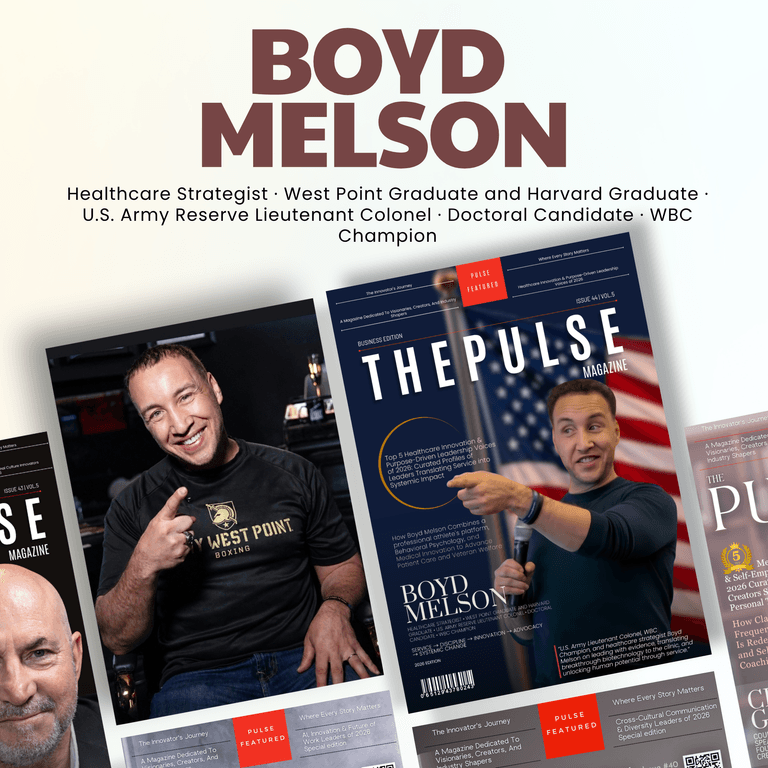
The Physics of Resilience: How Boyd Melson is Engineering Purpose from Pain
U.S. Army Reserve Lieutenant Colonel. West Point and Harvard graduate. WBC Champion who donated every cent of his fight purses to spinal cord injury research. In this exclusive Pulse Magazine feature, healthcare strategist Boyd Melson reveals how he translates physical discipline into medical disruption. Drawing on advanced behavioral psychology, biomimicry, and his upcoming documentary UNSEEN WARRIORS, Melson shares how he is actively dismantling bureaucratic complacency to demand systemic change for veterans and advance breakthrough clinical therapies.
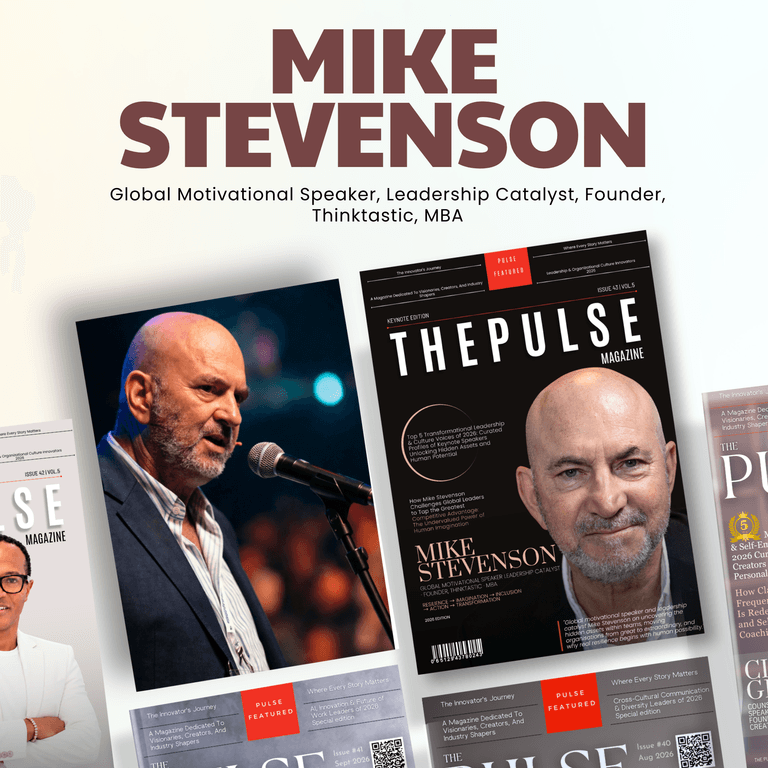
The Undervalued Power of Human Imagination: How Mike Stevenson is Redefining Label-Free Leadership
Global motivational speaker. Founder of Thinktastic. Executive catalyst who earned his MBA 43 years after being expelled from school. In this exclusive Pulse Magazine feature, Mike Stevenson reveals why true organizational resilience doesn't come from squeezing employees harder, but from unlocking the "hidden assets" already in the room. Drawing on his journey from sleeping rough in London to advising multinational boards, he explains why human imagination, not artificial intelligence remains the greatest competitive advantage in business today.
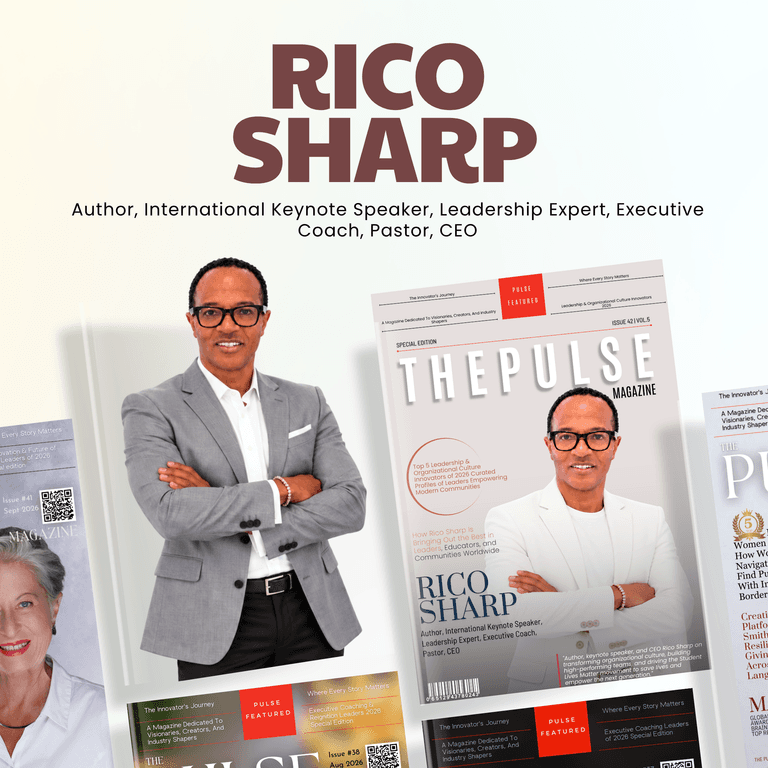
The WHO Factor: How Rico Sharp is Redefining Leadership and Organizational Culture
Author, international keynote speaker, and CEO. Beginning his transformational journey from a prison cell at age nineteen, Rico Sharp has spent three decades empowering leaders and communities worldwide. In this exclusive Pulse Magazine feature, Sharp reveals why organizations must hire for the "WHO" (character and integrity) rather than just the "WHAT" (credentials). He shares the philosophy behind his renowned leadership academies and explains how the Student Lives Matter movement is shifting the national paradigm from reactive crisis response to proactive violence prevention.