How Claire J. Gilchrist's Frequency Balance™ Method Is Redefining Mental Health and Self-Empowerment Coaching
In the silence of the 2020 lockdowns, when the world stopped and most careers were suspended, Claire J. Gilchrist went inward. In this exclusive Pulse Magazine feature, the Founder of The Self-Empowerment Hub reveals why she stopped treating mental health, communication, and leadership as separate problems — and the trademarked framework she built instead. She shares the 48 subconscious behavioural patterns behind Frequency Balance™, why she refuses to "fix" her clients on principle, and the ethical distinction that shapes everything she does.

In the silence of the 2020 lockdowns, when the world stopped and most careers were suspended, Claire J. Gilchrist went inward. What emerged was something she had been moving toward for two decades without yet having the conditions to see the whole: not a new programme, not a refined framework, but an entirely new therapeutic modality — Frequency Balance™.
Featured in The Pulse Magazine's Mental Health Innovation 2026 Special Edition, Gilchrist's profile traces an unusually wide-ranging career — professional actress, TV presenter, recording artist, counsellor, coach, and academic leader — unified by twenty years of pattern recognition that eventually produced a trademarked, clinically-grounded framework built to address the root causes of anxiety, depression, ADHD, and Bipolar disorder, rather than their surface symptoms.
Who Is Claire J. Gilchrist?
Claire J. Gilchrist holds a Masters in Metaphysical Science and a BA Hons from the University of the Witwatersrand. She is a Counsellor, Coach, Modality Creator, Speaker, Performer, and Academic Leader, and the Founder of The Self-Empowerment Hub, whose tagline, uncover the extraordinary in you, distills her entire professional philosophy into five words.
Before her twenty-plus year career in counselling, coaching, facilitation, training, and academic leadership, Gilchrist had an entirely different professional life in the performing arts: professional actress, TV presenter, voice artist, film lead, dancer, and recording artist. Her UK demo album was produced by Colin Thurston, the producer behind Duran Duran.
The Frequency That Changed Everything
Gilchrist had already spent twenty years counselling, coaching, and working with human beings across the full range of their challenges, anxiety, depression, ADHD, Bipolar disorder, trauma, performance blocks, anger, and panic issues, when the enforced stillness of the 2020 lockdowns created the conditions for a discovery she had been unknowingly moving toward.
She had sat with thousands of people. She had listened at a level of quality that comes only from years of genuine, disciplined attention. And across all those hours, in all those sessions, she had been quietly noticing something that she did not yet have the right framework to name.
The lockdown gave her time, not the usual practitioner's time of back-to-back sessions with moments for notes in between, but deep time: the kind in which patterns that have been accumulating across years of practice can finally be spread out, examined whole, and understood at the level of structure rather than symptom. She went inward. What emerged was Frequency Balance™, trademarked, backed by two decades of clinical and coaching observation, and built to address what she had been noticing all along in a language precise enough to work with systematically.
The 48 Patterns Beneath the Surface
Frequency Balance™ identifies 48 deeply subconscious behavioural patterns underlying the conditions that fill practitioners' waiting rooms worldwide: anxiety, depression, ADHD, Bipolar disorder, anger and panic issues, and relational patterns that repeat across different relationships and different decades. The conditions themselves are familiar. The address is new.
Most therapeutic approaches begin at the level of symptom. Frequency Balance™ begins at the level of the pattern producing it and the difference, in Gilchrist's account, is everything. Gilchrist identified 48 of these patterns as a taxonomy of the internal operating systems that drive behaviour, emotional response, relationship dynamics, and self-perception below the threshold of conscious awareness.
The word "frequency" is not merely metaphorical in Gilchrist's framework. It reflects a specific understanding of how deeply held beliefs and behavioural patterns operate in the human system as frequencies, oscillating patterns of response that the nervous system has learned to run as defaults, often without any conscious direction from the individual who is running them. Identifying which of the 48 patterns is active in a given person's system changes the nature of the work fundamentally: instead of only addressing the symptom, you are addressing the pattern producing it.
"The extraordinary isn't something you need to become. It's something you need to uncover. It's already there it has always been there and no amount of pain, difficulty, or accumulated self-doubt has actually taken it away."
The Professional Crucible: Eight Students a Day, and Nobody to Refer Them To
Before developing Frequency Balance™, Gilchrist's clinical instincts were forged in what she describes as probably the most important grounding for her broader career: a role at a private higher education institution, on a campus of more than a thousand students, where she held a position encompassing college counselling alongside Deputy Principal, Head of Student Affairs, and Liaison responsibilities.
In her first year in that role, she was seeing roughly eight students a day for counselling sessions. The student culture she encountered was one in which money was generally short, and counselling had not previously formed any part of most students' lives. When help was needed, there was suddenly a new person on campus who was ready to listen to anything and everything and the consequence was a volume and variety of presenting issues that would test a practitioner at any level of experience: anxiety, suicidal thoughts, relationship difficulties, academic failure, study problems, family conflict, bullying, financial stress, questions of sexuality, assault, pregnancy, identity confusion, grief, anger, depression, trauma, substance issues, or a crisis of confidence, frequently several of these at once.
"I don't fix people. I teach them to empower themselves using tools that work when they work them. That distinction isn't just methodological, it's deeply ethical. Change must live in the person. It can't be delivered from outside."
What the Absence of a Referral Pathway Teaches
The single most formative feature of the college counselling environment was the absence of anywhere else to send people. A practitioner working within a well-resourced clinical structure has a referral pathway for anything falling outside their particular competence, a genuine protection for the practitioner and, more importantly, for the client. Gilchrist discovered that when that pathway doesn't exist, the practitioner must grow.
She learned to think laterally. She could not rely on narrow diagnostic categories or think within a prescribed framework. The question she had to ask instead was more fundamental: what is actually happening here, and what does this person really need from me? Is that what I need to give? She became resourceful rather than protocol-dependent, because when there is nobody to refer a student to, saying that something falls outside one's scope of practice is not an available response.
Uncover the Extraordinary: Why Self-Empowerment Is an Ethical Stance, Not Just a Methodology
Gilchrist chose the phrase "uncover the extraordinary in you" with deliberateness. Five words that carry a philosophy, an ethic, and a practice all at once. She does not fix people. She teaches people to empower themselves using tools that work when they work them.
The distinction isn't semantic, it's foundational to everything she does. Gilchrist frames it explicitly as an ethical stance, a position about where change lives, who holds the power in the relationship between practitioner and client, and what happens when that power is located in the wrong place. When the practitioner is the fixer, the client is the fixed. The power dynamic is clear and, in Gilchrist's analysis, harmful: it locates agency, competence, and the capacity for change outside the person who needs to change, and it creates a dependency that serves the practitioner's sense of purpose more reliably than it serves the client's genuine development.
The empowerment model is built on a foundational conviction: every person already contains the capacity for the change they are seeking. The work of the practitioner is not to provide that capacity but to help the person access what they already have to uncover, not to install. Uncover is the operative word in Gilchrist's phrase, and it is not accidental. It implies that what is being sought is already present but obscured by fear, by conditioning, by the accumulated weight of patterns that have been running long enough to feel like identity rather than habit.
What Happens When the Boundary Is Crossed
Gilchrist is direct about what happens when the ethical boundary between empowering and fixing is crossed, and about how often it is crossed in the mental health and coaching fields, by practitioners who are well-intentioned and genuinely believe they are helping. The practitioner who becomes the source of the client's wellbeing is not serving the client's development, they are serving their own sense of being necessary. The client who relies on the practitioner's presence to maintain their equilibrium has not been empowered. They have been made more fragile by their capacity for self-regulation which has been externalised rather than developed.
The crossing of this boundary is rarely dramatic. It doesn't usually involve ethical violations or inappropriate relationships. It happens in the subtler territory of how sessions are framed, what questions are asked, who is positioned as the expert on the client's inner life, and whether the work being done is building the client's capacity for self-knowledge and self-direction or creating a relationship of informed dependency.
The One Foundation: Why Mental Health, Voice, and Leadership Are the Same Thing
The world of professional development and personal transformation is organized, for the most part, into silos. Mental health practitioners address psychological conditions and emotional wellbeing. Voice and communication coaches address how people sound and how they are perceived. Leadership and executive coaches address professional performance and organisational effectiveness. Each silo has its own institutions, credentials, literature, and community of practitioners who are highly skilled within their domain and largely unfamiliar with the others.
Gilchrist has spent twenty years working across all three domains simultaneously, and the central conviction of her practice is that this silo structure is not merely administratively inconvenient, it is clinically incorrect. Mental health, voice and communication presence, and executive performance are not separate categories. They are different expressions of the same underlying reality: the interior state of the human being who is trying to function in all of these domains at once.
Forthcoming Work
Gilchrist's forthcoming projects extend her integrated philosophy into new formats: The Simplicity of Stability, a mental health book and companion online course, and Confidently Speaking, a 5-person voice and speaking programme, alongside a dedicated Speaking Voice intensive programme.
Key Takeaways for Practitioners and Clients
- Symptom-level treatment has real limits — addressing anxiety, depression, or ADHD at the surface without addressing the subconscious pattern producing them tends to produce only temporary relief.
- Empowerment and fixing are not the same thing — a practitioner-as-fixer model creates dependency; a practitioner-as-guide model builds the client's own capacity for change.
- The absence of structure can build resourcefulness — Gilchrist's most formative clinical training came from an environment with no referral pathway, forcing lateral thinking over rigid protocol.
- Mental health, communication, and leadership are not separate domains — they are different expressions of the same underlying interior state, and treating them as siloed problems misses the deeper pattern connecting them.
- Change must be self-generated to last — tools only work when the client works them; lasting transformation cannot be delivered from outside the person.
This feature is based on Claire J. Gilchrist's profile in The Pulse Magazine's Mental Health Innovation 2026 Special Edition. Claire J. Gilchrist is Founder of The Self-Empowerment Hub and creator of the trademarked Frequency Balance™ modality.
Read more from The Pulse Magazine: thepulsemagazines.com | Follow us on LinkedIn and Instagram @thepulsemagazines
Related Stories
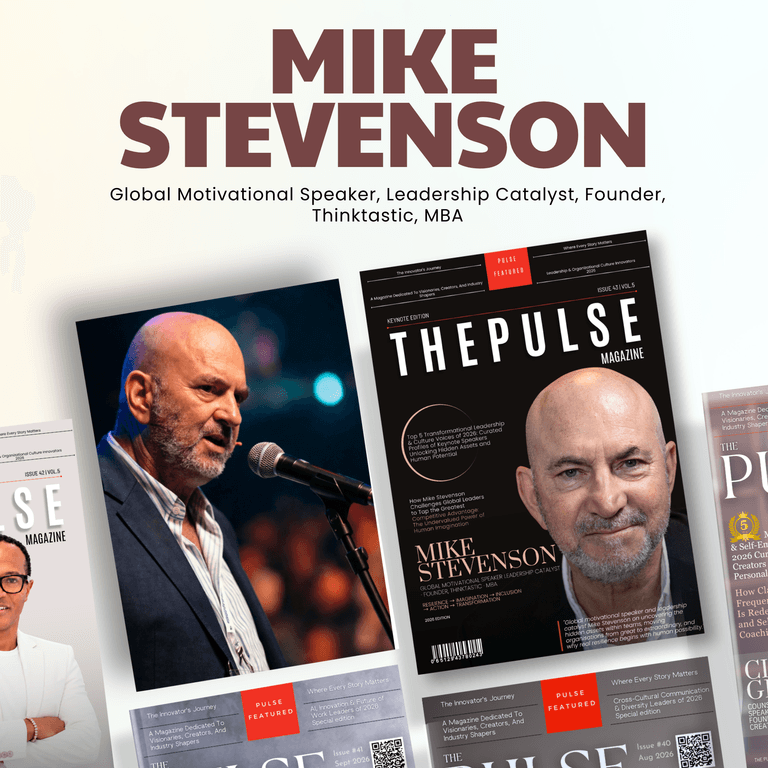
The Undervalued Power of Human Imagination: How Mike Stevenson is Redefining Label-Free Leadership
Global motivational speaker. Founder of Thinktastic. Executive catalyst who earned his MBA 43 years after being expelled from school. In this exclusive Pulse Magazine feature, Mike Stevenson reveals why true organizational resilience doesn't come from squeezing employees harder, but from unlocking the "hidden assets" already in the room. Drawing on his journey from sleeping rough in London to advising multinational boards, he explains why human imagination, not artificial intelligence remains the greatest competitive advantage in business today.

The WHO Factor: How Rico Sharp is Redefining Leadership and Organizational Culture
Author, international keynote speaker, and CEO. Beginning his transformational journey from a prison cell at age nineteen, Rico Sharp has spent three decades empowering leaders and communities worldwide. In this exclusive Pulse Magazine feature, Sharp reveals why organizations must hire for the "WHO" (character and integrity) rather than just the "WHAT" (credentials). He shares the philosophy behind his renowned leadership academies and explains how the Student Lives Matter movement is shifting the national paradigm from reactive crisis response to proactive violence prevention.

Augmenting Humanity: How Dr. CJ Meadows is Redefining Business Education for the AI Era
Harvard DBA. Author of 13 books. IDEO+ExperiencePoint-certified facilitator and innovation ecosystem builder. In this exclusive Pulse Magazine feature, Dr. CJ Meadows reveals why generative AI will not replace human leaders, but rather augment them to focus on what humans do best. Drawing on over three decades of consulting and teaching, she shares the design thinking philosophy shaping executives at S P Jain School of Global Management, and explains why true digital transformation is always 75% human work.