Now Reading: Camille Bradbury: Redefining HR Through Empathy, Strategy & Human-Centered Leadership | HRinsidr
-
01
Camille Bradbury: Redefining HR Through Empathy, Strategy & Human-Centered Leadership | HRinsidr

Camille Bradbury: Redefining HR Through Empathy, Strategy & Human-Centered Leadership | HRinsidr

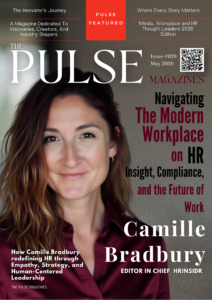
Issue #029 | May 2026 Media, Workplace and HR Thought Leaders 2026 Edition
The Innovator’s Journey | The Pulse Magazines
The workplace isn’t just evolving it’s being rewritten in real time. Structure, hierarchy, and predictability once defined how organizations operated. Today, those rules are being replaced by forces that demand something more nuanced: adaptability, emotional intelligence, and human-centered leadership.
In this issue of The Pulse Magazines, we focus on a domain that used to operate behind the scenes but now sits at the center of organizational success: Human Resources. Not as paperwork. Not as compliance alone. But as culture-shaping, people-protecting, strategy-driving work.
At the heart of this edition is Camille Bradbury, Editor in Chief of HRinsidr, whose multidimensional career spans hospitality, technology, consulting, and HR. Her story doesn’t follow a traditional ladder. It follows something more valuable: a commitment to learning across environments and translating complexity into clarity.
Camille’s core message is simple and urgent. In a world increasingly driven by automation and data, organizations are still built by people. Tools may change, but the human element remains constant. The future of work will be defined not only by technology, but by how leaders communicate, build trust, and protect belonging.
A Leader Built Across Disciplines
Camille Bradbury represents a leadership model that’s becoming more necessary each year: the connector. As she puts it, “The strongest professionals are not specialists they are connectors of knowledge across disciplines.”
Her earliest exposure to business wasn’t theoretical. It was immersive. Growing up in a family rooted in the restaurant industry high-pressure, high-standard, real-time execution she internalized what many professionals spend years learning:
- decisions have consequences immediately
- customer experience is operational, not abstract
- teams succeed when trust and rhythm exist
- excellence isn’t a slogan, it’s a habit
Restaurants don’t allow for delayed accountability. They train resilience through reality. That environment shaped Camille’s instinct for systems and later, her awareness that systems only work when people can function inside them.
Like many high-achievers, Camille originally imagined a structured path: law school, discipline, a defined trajectory. Then the 2008 recession hit an inflection point that forced a new kind of clarity.
Standing among hundreds of applicants for basic opportunities is not just a job search moment; it’s a reality check. For Camille, it became a directive: go where the work is and where the future is being built. She pivoted into technology not as a detour, but as a strategic repositioning.
That pivot became the beginning of a multidimensional journey across government, healthcare, nonprofit, corporate environments, and consulting. And over time, a pattern emerged: industries differ, but organizations repeat the same human failures.
Leadership misalignment. Communication breakdowns. Cultural disconnect. And the constant gap between strategy and execution.
The Turning Point: When Leadership Stops Being About Control
Camille’s leadership evolution is marked by a shift many leaders take years to reach: moving from authority-based control to influence-based connection.
Early leadership often rewards what is measurable: results, performance, output. But results alone don’t create cohesion. A team can hit targets while still feeling fractured. Camille recognized this through experience, not theory:
“I was focused on results, but I hadn’t yet understood that relationships drive those results.”
That insight changed how she approached leadership. She began to observe how people respond to pressure, how communication affects morale, and how trust determines consistency. The conclusion was clear: people aren’t extensions of a system they are the system.
This is where her leadership became transferable across industries. Because once you understand the human layer, you can lead anywhere.
The Birth of HRinsidr: Not More Content More Utility
As Camille moved closer to HR-focused work, she noticed a contradiction. HR professionals operate at the center of organizational life yet they are often under-resourced, under-recognized, and overwhelmed.
They are expected to manage:
- compliance and policy complexity
- employee relations and conflict
- leadership coaching and culture work
- hiring, retention, and workforce planning
- crisis response and emotional labor
But in many organizations, HR is still treated as a support function an administrative necessity, not a strategic partner. HR is expected to “fix” problems without being included in the decisions that created them.
Camille saw the gap clearly. The problem wasn’t a lack of information. It was a lack of practical, actionable insight. HR didn’t need more theory. HR needed tools that could be applied today.
That is why HRinsidr was created: a platform built on usability over abstraction. It’s designed around a different editorial question:
Not “What should we publish?”
But “What problem is HR trying to solve right now?”
HRinsidr prioritizes checklists, templates, frameworks, and grounded guidance content meant to be used, not admired. It is an editorial model aligned with the modern reality of HR: limited time, high stakes, constant change.
The Crisis of Modern HR: Burnout + Limited Influence
One of the most pressing themes in Camille’s work is the hidden burnout epidemic within HR. Not burnout from the work itself but from the structure around the work.
HR carries high responsibility with limited authority. HR is accountable for outcomes it doesn’t fully control. That imbalance creates chronic stress.
As this edition highlights:
“Burnout in HR doesn’t come from the work it comes from the imbalance between responsibility and influence.”
HR professionals also absorb significant emotional labor. They support employees through crises, mediate conflict, manage sensitive situations, and hold the psychological weight of organizational disruption often without their own support systems.
This is why Camille emphasizes a leadership shift: HR must be repositioned as a strategic driver, not a reactive fixer. Influence isn’t optional it’s essential.
AI and the Future of HR: Efficiency Without Losing Humanity
Artificial intelligence is transforming work at a pace few organizations were prepared for. In HR, AI can automate repetitive tasks, improve analytics, and reduce administrative burden. That should be relief.
But it also increases expectations. HR must now understand emerging tools, integrate systems, and lead teams through transitions all while preserving culture and connection.
Camille frames HR’s role in an AI-driven workplace as a bridge:
- between technology and people
- between data and emotion
- between efficiency and empathy
She also highlights the human connection paradox: as organizations become more technologically advanced, they risk becoming less human. Automation reduces interaction. Digital systems replace conversation. Efficiency can come at the cost of trust.
The future of work, Camille argues, will not be defined by technology alone but by how intentionally we preserve human connection alongside it.
This includes ethical questions HR must lead on: privacy, consent, bias, transparency. Just because something can be automated doesn’t mean it should be without considering impact.
Compliance: The Invisible Architecture of Organizations
Compliance is often treated like paperwork. Camille treats it as strategic infrastructure.
In today’s world, regulations change quickly. Interpretations shift. Remote and distributed workforces create multi-jurisdiction complexity. HR isn’t just managing compliance it’s navigating a moving target.
Camille’s approach emphasizes preparedness over reactivity:
- plan for multiple scenarios
- integrate compliance into strategy
- communicate policies clearly and simply
- build leadership accountability around compliance culture
Her core reminder is practical: if people don’t understand a policy, they can’t follow it. Clarity is a compliance tool.
Communication: The Real Leadership Superpower
Across Camille’s journey, one skill repeatedly emerges as the differentiator: communication.
Not communication as speaking but communication as being understood.
“Communication is not what you say it’s what people actually take away from it.”
Clarity reduces confusion, accelerates execution, and builds trust. Consistency creates stability. Transparency prevents speculation. And listening often overlooked is the foundation of influence.
Camille advocates for intentional over-communication during change. Not noise but reinforcement. If something matters, it’s worth repeating.
This matters even more in hybrid and remote workplaces, where culture can’t be assumed. It must be designed.
Legacy and the Future of Work: Impact Over Titles
As careers mature, success stops being about what you achieve and becomes about what you improve. Camille’s vision is rooted in impact: helping as many people as possible and creating environments where they can thrive.
Her definition of the future workplace is human-centered:
- psychological safety as a baseline
- leaders who learn continuously
- technology that enhances experience (not replaces it)
- HR positioned as a core strategic driver
If we build better workplaces, we build better lives. And ultimately, better organizations.
FAQ
1) Who is Camille Bradbury?
Camille Bradbury is the Editor-in-Chief of HRinsidr and a workplace/HR thought leader whose career spans hospitality, technology, consulting, and human resources. She is known for connecting insights across disciplines and translating workplace complexity into practical, people-first leadership guidance.
2) What is HRinsidr?
HRinsidr is a solution-driven platform created to support HR professionals with practical, actionable resources including frameworks, templates, and checklists designed to be applied immediately in real workplace situations.
3) Why was Camille Bradbury featured in The Pulse Magazines Issue #029?
She was featured for redefining modern HR through empathy, strategy, and human-centered leadership, and for offering a grounded perspective on the future of work especially around burnout, influence, compliance, and AI’s impact on workplaces.
4) What does Camille mean by “the strongest professionals are connectors”?
Camille emphasizes that modern workplace challenges rarely sit in one department. “Connectors” can integrate knowledge across business, technology, operations, and people strategy, making them more effective at solving cross-functional problems.
5) What is the biggest challenge facing HR today, according to this feature?
A central challenge is the imbalance between responsibility and influence. HR is accountable for major outcomes culture, compliance, employee experience yet is often not given enough authority, resources, or strategic visibility to drive those outcomes effectively.
6) How does Camille describe burnout in HR?
This feature highlights that HR burnout is intensified by:
- constant emotional labor (supporting others through conflict and crisis)
- complex compliance demands
- limited influence in decisions
- high expectations with insufficient support
7) What is Camille’s view on AI in HR?
Camille sees AI as both relief and pressure:
- Relief: automates repetitive tasks and enables HR to focus on strategy, culture, and leadership.
- Pressure: raises expectations, introduces ethical concerns (bias, privacy, transparency), and risks reducing human connection if used without intention.
8) Why is communication considered a “leadership superpower” in this edition?
Because communication creates clarity, alignment, and trust especially in times of uncertainty. The feature reinforces that communication isn’t what leaders say; it’s what people understand and act on.
9) What is the key takeaway from Camille’s leadership approach?
Leadership today is less about control and more about influence, trust, empathy, and clarity building environments where people feel valued and can perform sustainably.
How to Connect with Camille Bradbury
1) Connect via The Pulse Magazines (Editorial / Interview Requests)
- Email: info@thepulsemagazines.com
Mention Issue #029 (May 2026) and request to be connected with Camille Bradbury for interviews, speaking engagements, collaborations, or inquiries.
2) Connect via The Pulse Magazines Social Channels
- LinkedIn / Instagram: Camille Bradbury
Send a DM stating your reason for reaching out and ask for the best contact route for Camille.
3) Connect via HRinsidr (Official Platform)
- Visit HRinsidr’s official website and use its contact form or listed business email/social links (if available).
If you share the HRinsidr URL you’re using, I can draft a message tailored to the exact contact method on that page.