Trump Unveils $175 Billion ‘Golden Dome’ Missile Defense Shield with Space-Based Lasers
Former President Donald Trump introduces the ambitious ‘Golden Dome’ missile defense plan, featuring space-based lasers and multi-layered protection against missile threats — including hypersonic and orbital attacks. Learn about the project’s scope, cost, and geopolitical implications. Washington, D.C. — Former U.S. President Donald Trump has formally unveiled the “Golden Dome,” an ambitious $175 billion missile
Trump Unveils $175 Billion ‘Golden Dome’ Missile Defense Shield with Space-Based Lasers
Former President Donald Trump introduces the ambitious ‘Golden Dome’ missile defense plan, featuring space-based lasers and multi-layered protection against missile threats — including hypersonic and orbital attacks. Learn about the project’s scope, cost, and geopolitical implications.
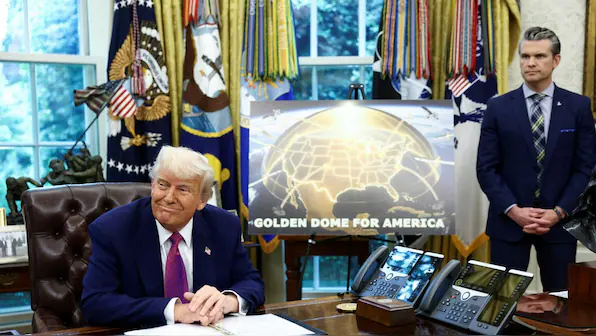
Washington, D.C. — Former U.S. President Donald Trump has formally unveiled the “Golden Dome,” an ambitious $175 billion missile defense initiative aimed at shielding the United States from modern missile threats — including those launched from space. Announced from the Oval Office, Trump described the system as “the most advanced defensive shield ever developed,” and claimed it will be “fully operational before the end of my term,” referring to January 2029.
What is the Golden Dome?
The Golden Dome is a multi-layered missile defense system designed to intercept threats at every stage of flight — from pre-launch and boost phase to midcourse and terminal descent. It integrates existing land-, sea-, and air-based systems like Patriot missile batteries, THAAD (Terminal High Altitude Area Defense), Aegis Ballistic Missile Defense, and Ground-based Midcourse Defense (GMD), while introducing cutting-edge space-based interceptors and possibly orbital laser weapons.
These directed-energy systems could enable rapid, high-precision targeting and neutralization of enemy missiles shortly after launch — a technological leap with the potential to revolutionize missile defense.
Leadership and Development
Gen. Michael Guetlein, Vice Chief of Space Operations, has been appointed to oversee the implementation and development of the program. The system’s visual presentation featured the continental U.S. covered in gold, symbolizing the nationwide protection envisioned under the Golden Dome.
Despite Trump’s confidence, military officials, including Air Force Secretary Troy Meink, have stated the system is still in the conceptual stage. The Department of Defense and U.S. Northern Command are currently drafting the initial capabilities document that will define its mission and technical requirements.
Cost and Funding Challenges
While the announced cost of the Golden Dome stands at $175 billion, the Congressional Budget Office estimates that the space-based components alone could cost over $542 billion over the next two decades. The Trump administration is seeking an initial $25 billion allocation through a new tax break bill moving through Congress.
The system is expected to come in three tiers of capability — medium, high, and “extra high” — depending on the scale and density of satellites and space-based interceptors.
Comparison to Israel’s Iron Dome
The name “Golden Dome” draws inevitable comparisons to Israel’s Iron Dome, but experts emphasize the differences. While Iron Dome protects small areas from short-range projectiles, the Golden Dome aims to cover the entire continental United States and defend against long-range ballistic, cruise, and hypersonic missiles — including those launched from space.
“This isn’t just about rockets or short-range threats; it’s about intercontinental and even orbital missile capabilities,” said Wes Rumbaugh, fellow at the Center for Strategic and International Studies.
Technical and Strategic Hurdles
The Golden Dome introduces significant engineering and geopolitical challenges. According to defense experts, deploying space-based laser systems would require infrastructure comparable to or exceeding the Hubble Space Telescope, both in size and complexity.
“It’s enormously ambitious, expensive, and potentially destabilizing,” said Michael O’Hanlon, Director of Research at the Brookings Institution. He noted that building a defense system capable of neutralizing a full-scale nuclear strike from Russia or China would likely provoke an arms race.
Indeed, Russia and China have jointly denounced the plan as “deeply destabilizing,” warning that it would militarize space and undermine global strategic balance.
Current U.S. Missile Defense Systems
While the Golden Dome is under development, the U.S. continues to rely on its existing defense infrastructure:
- Patriot Missile Batteries – For tactical missiles, aircraft, and cruise missiles.
- THAAD – Intercepts short- to intermediate-range missiles in the upper atmosphere.
- Aegis BMD – Sea-based system adapted for land to counter ballistic missile threats.
- GMD – Designed to intercept long-range missiles during midcourse flight.
- Avenger System – Mobile unit using Stinger missiles for aircraft and cruise missile defense.
These systems form a layered network, but none yet offer space-based interception capabilities — a gap the Golden Dome seeks to fill.
Geopolitical Impact and Strategic Risks
The introduction of a space-based missile shield risks escalating international tensions, particularly with Russia and China, who are already developing anti-satellite weapons. In 2023, U.S. intelligence claimed Russia was testing a nuclear-based orbital weapon designed to disable satellites.
While supporters argue that even a limited version of the Golden Dome could improve defense against rogue states like North Korea or Iran, others warn that the project’s scope and cost could strain the defense budget and fuel an arms race.
“Even a partially effective system could offer real benefits,” O’Hanlon noted, “but if you’re aiming to protect against a full-scale nuclear barrage, the costs quickly become astronomical.”
Conclusion
Trump’s Golden Dome missile shield marks a bold new chapter in American defense strategy, combining traditional missile interception with next-generation space technologies. However, with costs likely to exceed half a trillion dollars and many technical and geopolitical challenges ahead, the success of the Golden Dome remains uncertain — for now, it’s more a vision than a reality.
Related Stories

The Fire Is Never Gone, It Is Buried: Allisa Verhille on Reigniting High-Achievers Before Burnout Costs Them Everything
Allisa Verhille has delivered nine-figure results, stood on the stages of Oxford and Columbia, and built organizations from almost nothing to extraordinary scale. But the story that matters most began at a bathroom sink, years into a career that looked perfect from the outside, the night she looked into the mirror and did not recognize the woman looking back.
Change of British High Commissioner to New Zealand
Ms Louise Cantillon has been appointed British High Commissioner to New Zealand and Governor of the Pitcairn, Henderson, Ducie and Oeno Islands.
Trump signs order to limit childhood vaccines and split MMR shots
The American Academy of Pediatrics calls the recommendation on measles, mumps and rubella shots "dangerous".