The Outside Catches Up With the Inside: Lise Bruynooghe on Why Leadership Change Never Starts Where You'd Expect
A bewildered question from a company president, did you get new glasses? Became the foundation of an entire coaching practice. In this exclusive Pulse Magazine feature, Master Certified Coach and ICF Global Enterprise Board Chair Lise Bruynooghe reveals why leadership breakthroughs rarely happen in the office, why nothing around a leader shifts until they do, and how two days on a Swiss mountainside can surface what years of boardroom conversation never could.
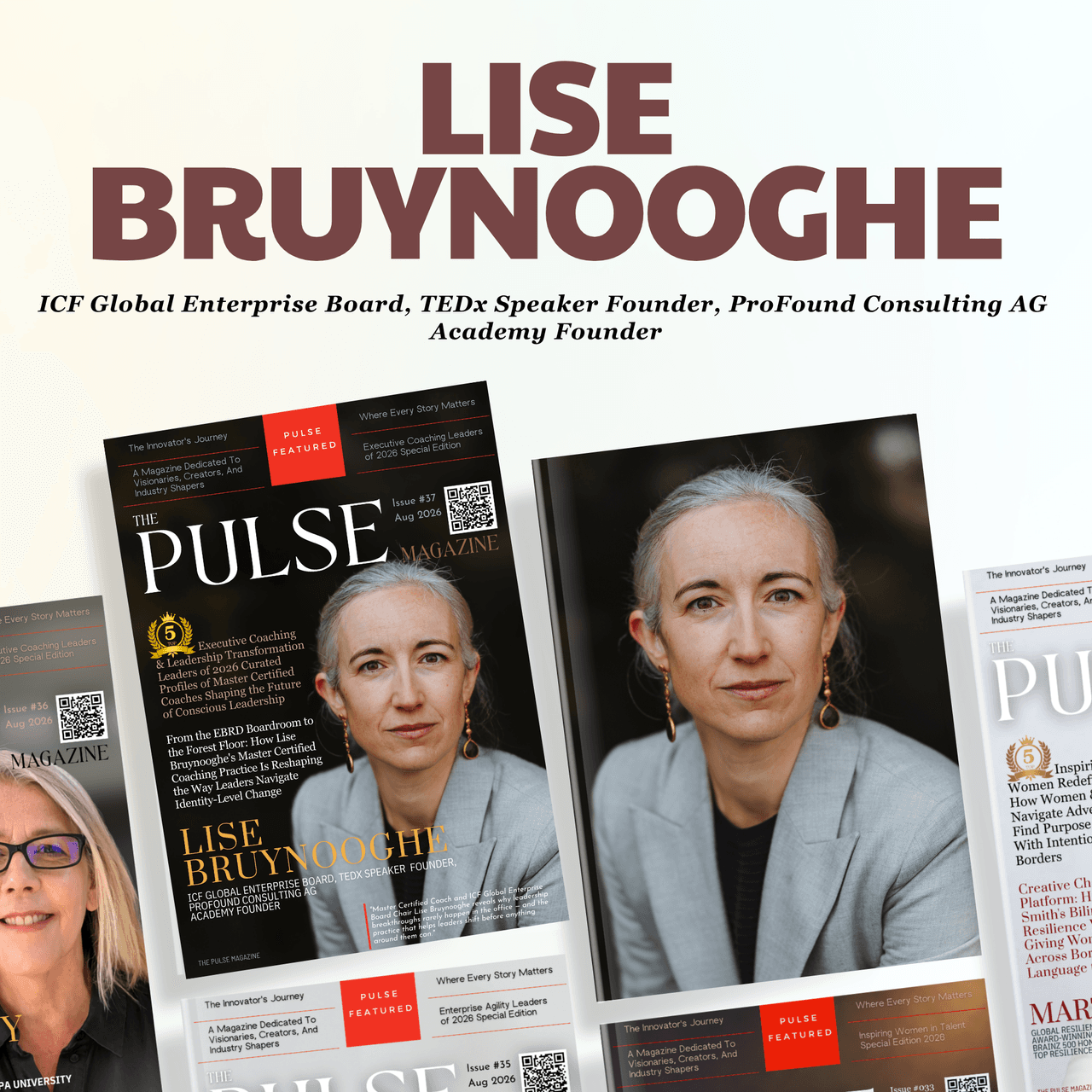
Lise Bruynooghe holds one of the rarest credentials in her field, Master Certified Coach. The highest designation awarded by the International Coaching Federation and one of its most unusual practices, built as much on Swiss mountainsides as on institutional boardrooms. Her central conviction, refined over a career that spans eleven years at the European Bank for Reconstruction and Development, a seat on the ICF Global Enterprise Board, and the founding of her own coaching academy, is deceptively simple: nothing around a leader will shift until they do.
Featured in The Pulse Magazine's Executive Coaching Leaders of 2026 Special Edition, Bruynooghe's profile traces how a single bewildered question from a company president became the foundation of an international coaching practice built on identity-level change, the kind of transformation that no surface-level intervention, and increasingly, no AI system, can replicate.
Who Is Lise Bruynooghe?
Lise Bruynooghe is a Master Certified Coach (MCC), Chair of the ICF Global Enterprise Board, TEDx speaker, and Founder of ProFound Consulting AG and its ICF-accredited coaching Academy. Her academic background spans Sciences Po Paris, MGIMO Moscow, and University College London, and she spent over eleven years at the European Bank for Reconstruction and Development (EBRD), including roles as Director of Organisational Design and Principal Advisor to the President.
The ICF Global Enterprise Board she chairs oversees a profession that reaches an estimated 430 million lives touched by professional coaching annually placing her governance work at the center of decisions about credentialing, standards, and the profession's future direction.
The Question That Started Everything
Bruynooghe's central conviction didn't arrive as a philosophical position adopted from reading or training. It arrived as a direct, personal experience. While studying coaching skills, the president of her organization looked at her one day with evident curiosity and asked whether she had new glasses or a new haircut. She hadn't. Nothing external had changed, what he was picking up on was entirely internal: a shift in how she occupied space, how she listened, how she carried herself. He reached for the nearest visible explanation because he had no vocabulary for what he was actually perceiving.
"The outside catches up with the inside. Never the other way round."
That single observation, made in miniature, became the foundation of a practice that now operates across the mountains of Switzerland, the governance chambers of the ICF Global Enterprise Board, and the most pivotal moments of some of the world's most complex leaders.
Identity-Level Change: Why Surface Interventions Don't Stick
Bruynooghe's coaching practice centers on what she calls identity-level change — work that begins with the stories a leader has been telling themselves about who they are, what they're capable of, or must be to be taken seriously, to be safe, to be loved. These stories are inherited, not invented in adulthood: from conditioning, parents, teachers, and the particular circumstances that shaped a person's fundamental beliefs before they ever consciously chose them.
She's clear-eyed that surface-level coaching work addressing specific, bounded challenges, has real value. But it addresses symptoms while leaving causes intact. And AI, she notes with characteristic directness, has become increasingly capable of delivering surface-level coaching interventions very effectively. The territory she occupies deep, identity-level work with leaders at their most pivotal moments is precisely the territory AI cannot reach.
"Inner tone becomes outer climate. One unexamined leader can shift the mood of an entire department without ever raising their voice. Multiply that across a company, a country, a generation and you see why this work matters."
What Identity-Level Change Actually Looks Like
Bruynooghe describes this through lived specificity rather than abstract theory. It looks like a CEO who has spent a career performing strength and competence, suddenly finding the courage to say, to herself and then to her team, that she does not know. It looks like a leader who has been hiding a significant dimension of who they are a background in the arts, a contemplative spiritual practice, a family story of hardship, finally integrating that dimension into their professional identity, and discovering it makes them more compelling rather than less.
It feels, initially, like losing something. Leaders who have built their identities around particular self-concepts being the person who always has the answer, who never shows doubt, who drives results without pausing to examine the internal cost often experience the early stages of identity-level work as a kind of destabilisation. The scaffolding that has been holding them up turns out to have been constraining them. Removing it feels dangerous before it feels freeing.
"Nothing around a leader will shift until they do. That is a radical claim. It is also the most accurate description of how change actually works that I have found in thirty years of watching it."
The Forest as Coach
The nature-based dimension of Bruynooghe's practice didn't emerge from an ideology about the outdoors, it emerged from a client. A CEO brought a topic so large and so complex that Bruynooghe found herself unable to see how a one-hour Zoom session could create the conditions for genuine movement. She invited the CEO to come to Switzerland for two days in the mountains.
One walk that stayed with her vividly involved a senior leader whose company was mid-acquisition, who had just been required to let go of half her team. On the first day, the leader walked fast, urgently fast, the pace of someone managing difficulty through movement and productivity. Bruynooghe matched her pace without comment. On the second day, she chose the steepest route she could find and offered no breaks. The leader waited.
Eventually, genuinely out of breath after a sustained climb, the leader stopped and asked a genuine question rather than a rhetorical one: why am I being so hard on myself? The question emerged not from the coach but from the leader's own body from the specific experience of extended physical effort she had not been managing or controlling.
"In nature, nothing is controlled. The weather changes, animals come and go, rivers flow. That has an impact on your body, your thinking, your creativity. The office can never do what a mountain can."
Another client, who had never been on a mountain before in his life, had recently started a CEO role and was experiencing significant imposter syndrome. At the very top of the mountain, looking out across a range of snow-capped peaks, he simply stood there and knew with a certainty that required no words or argument that he could do the job.
Chairing the ICF Global Enterprise Board
Bruynooghe took on the role of Chair of the ICF Global Enterprise Board not because she's comfortable with institutional governance politics, but because she believes that where the ICF matters most is in its capacity to think about impact beyond the individual coaching engagement. The numbers make the case for why this matters: approximately 430 million lives are touched by professional coaching in a single year, not a niche profession, but a field with genuinely significant social reach whose potential to shape how leadership is practiced across organizations, sectors, and cultures remains substantially unrealized.
The tensions she navigates at board level are genuine, without tidy resolution: stability versus adaptability, universality versus cultural specificity, and the gap between broadening access to coaching and protecting the credential's value.
"430 million lives are touched by professional coaching in a single year. That is not a niche anymore. The question is whether we are being serious enough about what that reach could do."
You Are the Instrument
The ICF-accredited Academy Bruynooghe founded is built around a core pedagogical conviction: presence cannot be faked, and technical competence, while necessary, is only useful when the instrument delivering it, the coach is properly tuned.
She illustrates this with a coaching session she once reviewed: every intervention was well-timed, every question correctly formulated, the structure entirely sound. And the session was average. The practitioner had rushed into the session from another commitment without a moment to breathe or prepare. His attention had been scattered when he began, and it hadn't settled sufficiently for the duration of the session. The client could feel it, even if they couldn't articulate why the session felt slightly off.
"You are the instrument. If the instrument isn't tuned, it doesn't matter how good the technique is. That is what the Academy is built to develop, not just skill, but the person who delivers it."
The Academy's approach places the coach's own interior development alongside their technical training & engaging participants with their own beliefs, patterns, and identity-level questions as integral to the training itself, not a separate therapeutic track.
Dancing in the Moment: The TEDx Talk Behind the Philosophy
Bruynooghe's TEDx talk, Dancing in the Moment, has an origin more personal than most speaking topics: her son Julien's cancer diagnosis. She was standing, not sitting, when the doctors told her.
At that point in her life, she had five-year plans, ten-year plans, twenty-year horizons for her career, her family, everything she was building. The diagnosis made all of those plans irrelevant overnight. Not wrong, not failed, but simply irrelevant, as though the future she had oriented toward had quietly stepped aside and been replaced by something entirely unpredictable.
"I had five-year plans, ten-year plans, twenty-year horizons. The diagnosis made them irrelevant overnight. That was the beginning of understanding what dancing in the moment actually means."
From the EBRD Boardroom to Founding ProFound
Bruynooghe's shift away from institutional life came gradually, then all at once. She describes noticing that her reaction to colleagues leaving the EBRD had changed, from curiosity about why someone would leave, to envy. That shift, she says, is itself a form of embodied intelligence: the body knows before the mind does, and she trains her clients to take that signal seriously in themselves.
The timing carried real personal stakes. Her son Julien was undergoing intensive chemotherapy treatment at Great Ormond Street Hospital in London during the period she was weighing the decision to leave. Within less than eight weeks of her husband becoming ready to relocate, they had packed their lives up and left London, turning down a managing director role the previous year, at the last moment, with no backup plan, purely because something did not feel right in her body.
She doesn't look back at her eleven-plus years at the EBRD with ambivalence. It was, in her words, her baptism of fire for anything change-related, giving her the opportunity to observe change across industries, countries, and organisational contexts, including the complex internal dynamics of a major international institution navigating its own evolution.
Key Takeaways for Leaders and Coaches
- Real change starts on the inside, not the outside — external shifts in behaviour or performance follow internal shifts in identity, not the other way around.
- Surface-level coaching addresses symptoms, not causes — and is increasingly replicable by AI; identity-level work is not.
- The body often knows before the mind does — emotional and physical signals carry information rational analysis hasn't yet articulated.
- Environment shapes the depth of coaching work — uncontrolled, unpredictable settings (like nature) can access dimensions of a leader that a controlled office environment cannot.
- The coach is the instrument — technical skill only delivers value when the practitioner's own presence and inner tuning are equally developed.
This feature is based on Lise Bruynooghe's profile in The Pulse Magazine's Executive Coaching Leaders of 2026 Special Edition. Lise Bruynooghe is a Master Certified Coach, Chair of the ICF Global Enterprise Board, TEDx speaker, and Founder of ProFound Consulting AG and its Academy.
Read more from The Pulse Magazine: thepulsemagazines.com | Follow us on LinkedIn and Instagram @thepulsemagazines
Related Stories
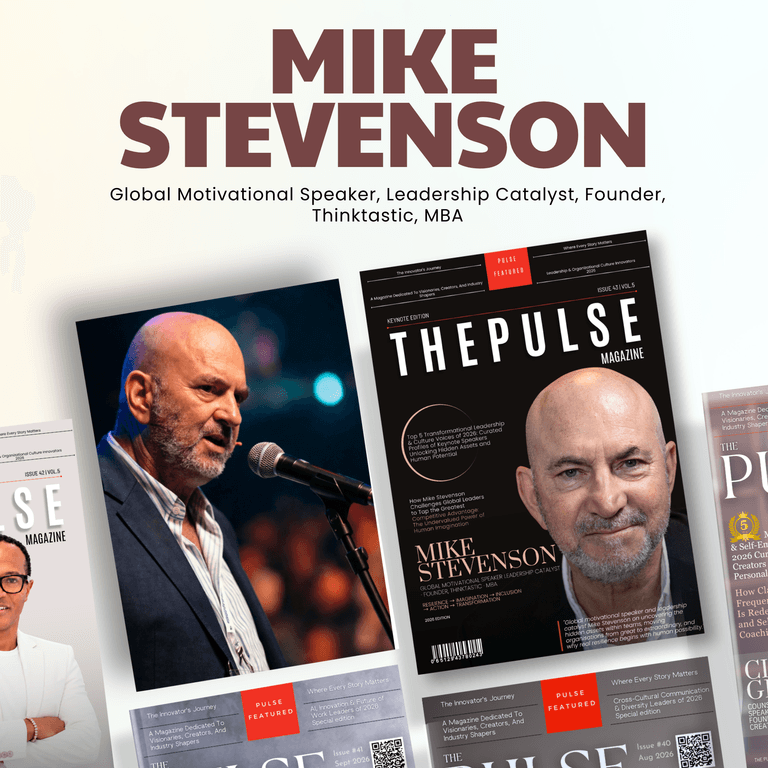
The Undervalued Power of Human Imagination: How Mike Stevenson is Redefining Label-Free Leadership
Global motivational speaker. Founder of Thinktastic. Executive catalyst who earned his MBA 43 years after being expelled from school. In this exclusive Pulse Magazine feature, Mike Stevenson reveals why true organizational resilience doesn't come from squeezing employees harder, but from unlocking the "hidden assets" already in the room. Drawing on his journey from sleeping rough in London to advising multinational boards, he explains why human imagination, not artificial intelligence remains the greatest competitive advantage in business today.
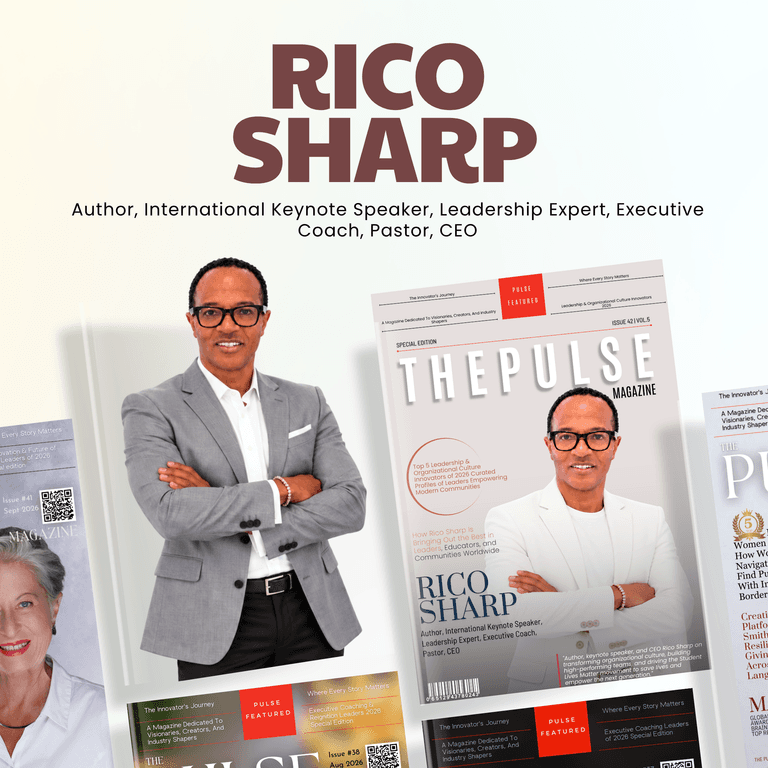
The WHO Factor: How Rico Sharp is Redefining Leadership and Organizational Culture
Author, international keynote speaker, and CEO. Beginning his transformational journey from a prison cell at age nineteen, Rico Sharp has spent three decades empowering leaders and communities worldwide. In this exclusive Pulse Magazine feature, Sharp reveals why organizations must hire for the "WHO" (character and integrity) rather than just the "WHAT" (credentials). He shares the philosophy behind his renowned leadership academies and explains how the Student Lives Matter movement is shifting the national paradigm from reactive crisis response to proactive violence prevention.

Augmenting Humanity: How Dr. CJ Meadows is Redefining Business Education for the AI Era
Harvard DBA. Author of 13 books. IDEO+ExperiencePoint-certified facilitator and innovation ecosystem builder. In this exclusive Pulse Magazine feature, Dr. CJ Meadows reveals why generative AI will not replace human leaders, but rather augment them to focus on what humans do best. Drawing on over three decades of consulting and teaching, she shares the design thinking philosophy shaping executives at S P Jain School of Global Management, and explains why true digital transformation is always 75% human work.