Don't Ask What AI Can Do For You: Jon Ward on Why Transformation Fails in the Corridors, Not the Boardroom
Jon Ward has spent thirty years at the frontier of enterprise transformation as a management consultant, three-time Group CEO, Business Agility Ambassador, published author, and now, architect of governance frameworks for agentic AI. His central message to boards in 2026 is blunt: don't ask what AI can do for you. Ask what your business is actually for and only then ask which mechanism, human or machine, gets you there fastest without losing control of it.
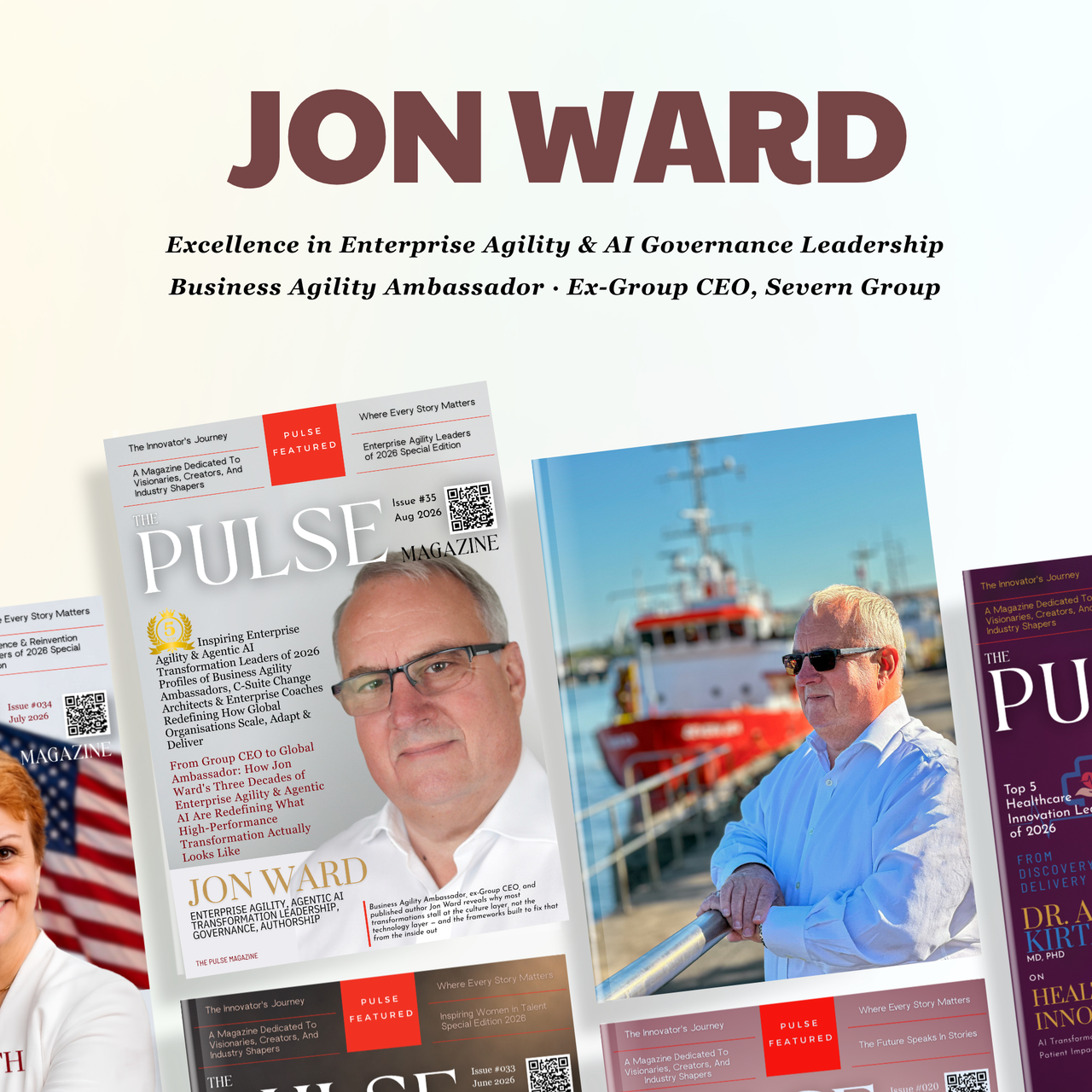
Featured in The Pulse Magazine's Enterprise Agility Leaders of 2026 Special Edition, Ward's profile is a rare thing in the transformation-consulting world: a career built not on theoretical frameworks, but on measurable, board-defensible results and an increasingly urgent warning about what happens when organisations adopt powerful new technology without first deciding who's accountable for it.
Who is Jon Ward?
Jon Ward is a transformation leader, author, and Business Agility Ambassador for the Agile Business Consortium, with more than 30 years of experience spanning financial services, telecoms, insurance, retail, and most recently agentic AI governance. He holds an MBA, is a SAFe SPC and Certified Agile Coach, and has held three separate Group CEO / Managing Director roles, including at Severn Group, which he grew from two consultants to over one hundred across offices in London, New York, and Frankfurt.
His client roster includes JP Morgan, the London Stock Exchange Group (LSEG), Experian, Barclays, Morgan Stanley, Swiss Re, and Priceline.com and his engagements have produced results most consultancies would hesitate to put in writing: a 52% reduction in feature lead time across 650 teams at JP Morgan, a 54% reduction in delivery lead time at LSEG within four months, and a 50% reduction in project duration at Experian.
The Philosophy That Predates Every Framework
Before any methodology, certification, or governance model, Ward's approach rests on one disarmingly simple commitment: help people grow. Not restructure organisations. Not help boards articulate strategy. Help the individual people inside an organisation discover what they're capable of, and build the conditions where that capability gets used.
That philosophy was forged the hard way through his own early management mistakes building Severn Group, where he learned a hard truth: a consultancy is fundamentally a people business, and getting better at growing people isn't a soft ambition. It's a commercial one.
Where Transformation Actually Fails
Ward's most important diagnostic insight is about location — where transformation efforts actually break down. It's not the boardroom.
"Transformation doesn't fail in the boardroom. It fails in the meeting rooms and corridors in the handoffs between teams, in the daily decisions middle managers make when no one senior is watching. If I have one philosophy, it's that I go and stand in those corridors." — Jon Ward
This is a philosophy of proximity: get close to the actual work, listen to the people doing it, measure what's really happening rather than what the plan says should be happening and stay close long enough to see whether change actually becomes real.
Evolution, Not Transformation
Ward pushes back on the word "transformation" itself, citing complexity theorist Dave Snowden's observation that the term is frequently misleading, implying apocalyptic, caterpillar-to-butterfly change that few businesses actually undergo. What most organisations need instead is evolution: the gradual, purposeful development of organisational capability in line with purpose, customer needs, market conditions, and brand promise.
The problem, as Ward sees it, is that evolution doesn't generate the same internal energy or justify the same scale of investment ask to a board and so the industry defaulted to "transformation" instead, and has been paying for that rhetorical choice ever since in failed programmes and accumulated workforce cynicism.
The Twenty Percent That Delivers the Eighty
Ward describes his intellectual framework as essentially Paretian and relentlessly focused on the 20% of action that delivers 80% of the outcome. His methodology typically starts small and evidence-driven: three teams, three months, specific measurable improvements, before asking a board to commit to enterprise-wide change.
The LSEG engagement is his clearest example. Coaching lead Mike Pelliccia challenged Ward directly: "I don't know what Agile is going to give me." Rather than arguing the case theoretically, Ward asked for three teams and three months, offering to return with Pelliccia's own numbers rather than generic industry benchmarks. Eight weeks later, with significant lead time reductions demonstrated, Pelliccia authorised incremental adoption across his entire function
"Senior executives need evidence — metrics that show why they should change and suggest improvement targets. An executive will argue with your opinion. They will not argue when presented with their own data." — Jon Ward"
Agentic AI: A Different Order of Thing Entirely
Ward draws a sharp and increasingly urgent line between generative AI and agentic AI. Generative AI answers a question; a human can review and correct it. Agentic AI acts on your behalf, inside live organisational systems, at machine speed, without waiting for a human to check every step.
"Don't ask what AI can do for you. Ask what your business is actually for and only then ask which mechanism, human or machine, gets you there fastest without losing control of it." — Jon Ward
His warning is specific: these are not two points on the same spectrum. They are fundamentally different categories of risk. A flawed generative AI recommendation is contained the moment a human reviews it. A flawed agentic AI system can make thousands of decisions inside real operations, before anyone notices something has gone wrong.
The Governance Framework Ward Has Built
Ward's current work centers on building a Digital Twin of a software engineering function, using AI and live delivery data to calculate metrics, including software quality levels and the causes of defects. Rather than through periodic manual analysis. But he's clear that the harder problem was never the modelling. It was governance.
His governance framework rests on three non-negotiable elements:
- A named owner not a committee, a specific accountable person.
- An approval gate for any AI action above a defined threshold.
- An accountable human whose responsibility for the system's decisions is personal and enforceable, not shared or ambiguous..
"A failed agile rollout wastes a budget and a year of goodwill. A badly governed agentic system doesn't wait for your quarterly review. It acts continuously at machine speed. By the time a human notices, it may have made thousands of decisions on the organisation's behalf." — Jon Ward
The Leaders Who Will Not Thrive
Ward is direct about which organisations are heading for trouble. It's the ones who adopted AI because competitors did, because a board member read an article, or because a vendor's pitch was compelling, without first asking what transformation they're actually trying to achieve, why AI is the right mechanism for it, and who is personally accountable if it goes wrong.
He's seen this exact pattern before, with agile. Organisations adopted Scrum because other organisations were adopting Scrum and were later bewildered when the rollout produced more meetings and more frameworks without producing faster delivery or higher quality. His warning: agentic AI will be adopted faster, and more broadly, than agile ever was and the consequences of getting the leadership and governance wrong will be correspondingly larger.
The View From the Chair: What Being a CEO Teaches That Consulting Never Can
Having held three separate senior leadership roles including Group CEO of Severn Group. Ward brings something most external consultants lack: personal, financial exposure to the consequences of his own advice.
"Pure consultants tend to optimise for the plan looking right on paper. Founders learn to optimise for what actually survives contact with a P&L or a customer. Those are fundamentally different disciplines." — Jon Ward
That experience, he says, gives him standing to challenge senior executives in ways a consultant without that background couldn't, because he's not describing risks he's read about. He's describing risks he's personally navigated.
Two Ears, Two Eyes, One Mouth
Ward's diagnostic methodology is built on a simple sequencing principle: observe, listen, collect data — only then form and test a hypothesis about what's actually broken.
"God gave us two ears and two eyes and only one mouth for a purpose. They should be used in that order of priority. Most organisations have employed very capable people who will tell you what is wrong, if you are willing to listen." — Jon Ward
The most important information about what's actually broken in an organisation, he argues, is almost never in the briefing documents. It's in the corridor conversations, in who's invited to which meetings, and in the gap between what leaders say the culture is and what middle managers actually do under pressure.
Mechanisms Serve Strategy — Not the Other Way Around
If there's one belief Ward wants every reader to take away, it's this: frameworks are tools, and tools serve purposes, not the reverse. Scrum serves delivery. SAFe serves scaled coordination. Agentic AI serves operational speed. None of them are goals in themselves.
"Enterprise Agility is an organisational capability which enables the rapid changing of an organisation's value creation model and resulting in resilience, growth, and profit. It is a business capability, not a software engineering practice." — Jon Ward
Jon Ward's Career in Milestones
- 1980s — Working at the BBC, Ward meets Tim Berners-Lee shortly before he invents the World Wide Web — an early lesson in recognising technology's true scale of impact.
- Severn Group — Founds and scales the consultancy from 2 to 100+ consultants across London, New York, and Frankfurt.
- JP Morgan — Delivers a 52% feature lead time reduction across 650 teams, one of his flagship transformation results.
- DAVSC — Becomes one of 25 elite practitioners developing the Disciplined Agile Value Stream Consultant curriculum.
- 2026 — Named ABC Thought Leader & Ambassador, builds Digital Twin AI governance frameworks, and features on The Pulse Magazine's cover.
The Question That Precedes the Tool
Ward's most concentrated piece of advice for boards is a reframing of the question they're currently asking. Most boards ask: what can AI do for us? That's the wrong question, one technology vendors are perfectly positioned to answer in their own favour.
The right question, Ward insists, is: What is our business actually for? And only then: which mechanism, human or machine, gets us there fastest without losing control of it?
Key Takeaways for Business Leaders
- Transformation fails in the corridors, not the boardroom — proximity to the actual work is the prerequisite for understanding what's really broken.
- Evidence beats opinion — executives argue with your opinion; they don't argue with their own data.
- Agentic AI is a categorically different risk than generative AI — it acts at machine speed, inside live systems, without waiting for review.
- Governance needs a named, accountable human — not a committee, and not a vendor.
- Frameworks are mechanisms, not strategies — agile, agentic AI, and every other tool exist to serve a business goal, never the other way around.
CERTIFICATE OF RECOGNITION
Outstanding Achievement Award
EXCELLENCE IN RESILIENCE & GLOBAL MENTORSHIP

This feature is based on Jon Ward's profile in The Pulse Magazine's Enterprise Agility Leaders of 2026 Special Edition. Jon Ward is a Business Agility Ambassador, ex-Group CEO, published author, and AI governance architect.
Read more from The Pulse Magazine: thepulsemagazines.com | Follow us on LinkedIn and Instagram @thepulsemagazines
Related Stories
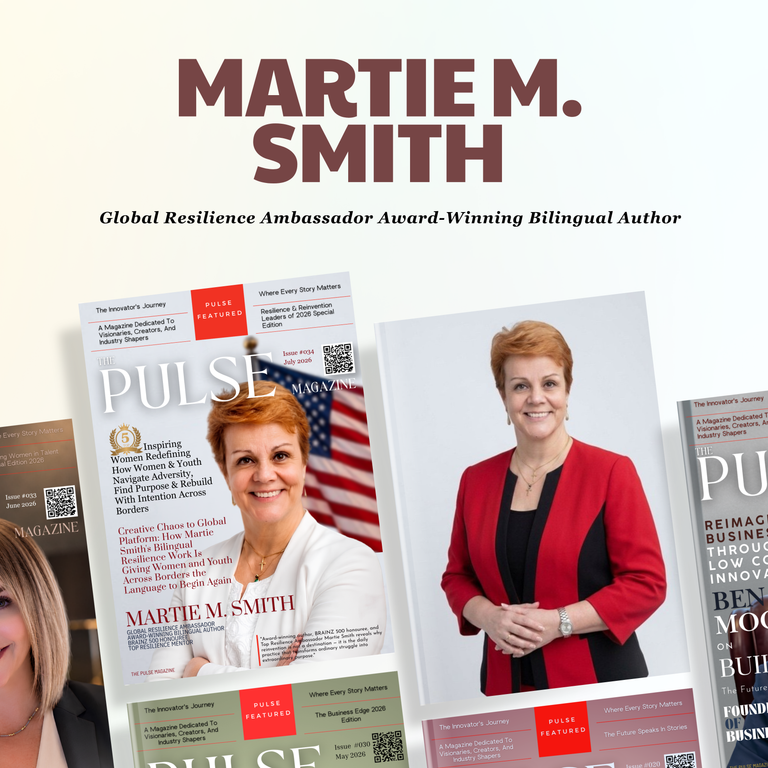
Reinvention Is Not a Destination: How Martie M. Smith Turned a Lifetime of Change Into a Mission of Resilience
Martie M. Smith has been a mechanic, a U.S. Air Force veteran, a radiation therapist, a STEM educator, a furniture builder, a photographer, an award-winning bilingual author, and a global mentor. On paper, it reads like someone who couldn't settle. In practice, it's the story of someone who kept learning to begin again — and built a life's mission out of teaching others to do the same.
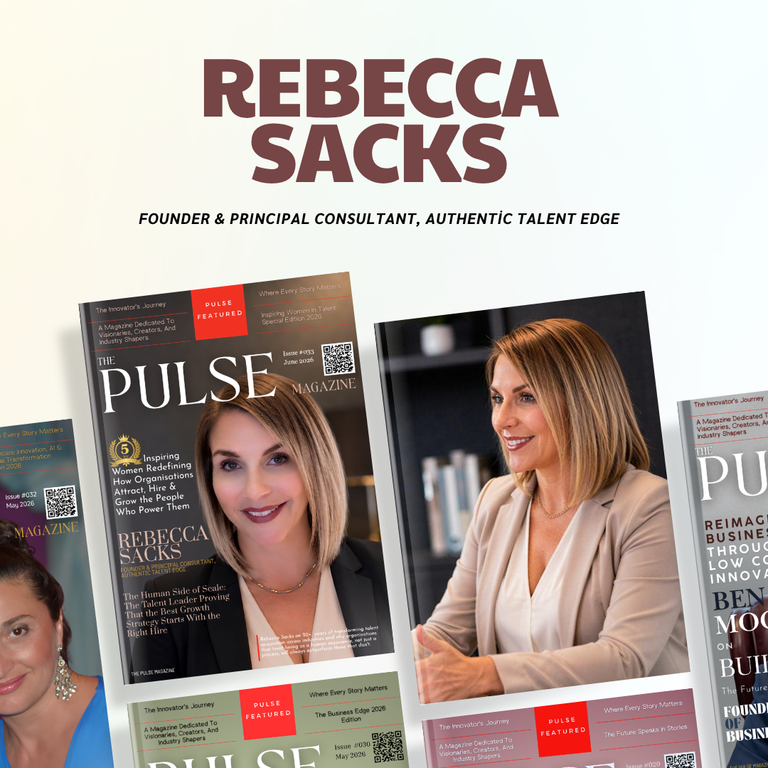
How Rebecca Sacks Is Proving the Best Growth Strategy Starts With the Right Hire
There is a version of leadership most people learn first, the one built on hierarchy, control, and being served. Rebecca Sacks, Founder & Principal Consultant of Authentic Talent Edge, built her 20+ year career proving there's a better one. In this exclusive Pulse Magazine feature, she breaks down why talent acquisition is the most under-leveraged growth lever in business, what AI can never replace in recruiting, and why the organizations that treat hiring as a human experience, not a process and are the ones that build lasting, high-performing teams.
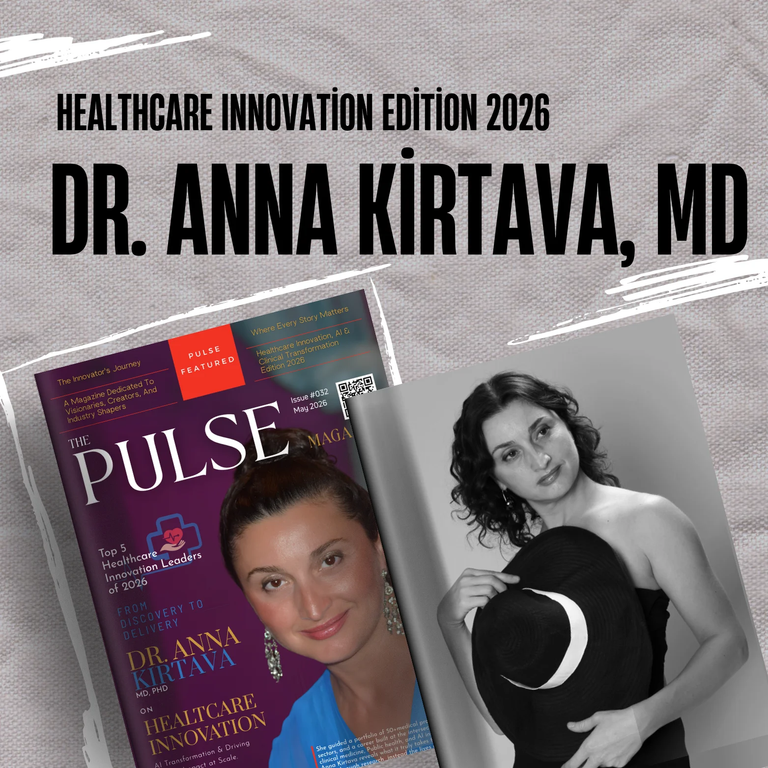
Dr. Anna Kirtava, MD, PhD: The Bridger Redefining Healthcare Innovation | The Pulse Magazine
Dr. Anna Kirtava, MD, PhD: The Bridger Redefining Healthcare Innovation, AI Governance & Global Health Equity